Saudi mosque halls, villa compounds, and commercial fit-outs already pull Pakistani white. The failure mode is shade lots at scale. This guide shows how to source Buner marble for Saudi Arabia with honest specs, Dammam/Jeddah/Riyadh logistics, and mill-gate evidence—not a fake certificate list.
Saudi projects eat white marble in quantities that embarrass a single WhatsApp mill. A mosque hall, a villa compound in Riyadh, a Jeddah waterfront lobby—each wants a field that still reads as one stone after three or seven containers. That is why Pakistan marble Saudi Arabia searches keep landing on Buner. The district has the factory density. Bampokha and Super White have the commercial names. The failure is not geology. It is shade-lot discipline at scale, plus logistics into Dammam, Jeddah, or Riyadh that nobody wrote on the RFQ. This guide is the Saudi operating layer on top of Buner white export grades.
It is not a certificate mill. SASO, SABER, and related import rules change and belong to your Saudi broker and the importer of record—not to a Torwarsak owner inventing PDF numbers. We will stay at that honest altitude: tell the mill what to produce and photograph; tell your broker what to file. Fake SABER talk in a marble blog is how buyers get hurt. Real talk is lots, metres, and ports.
Why Saudi programmes pick Buner whites
Mosque interiors want a calm field, often honed or polished, often large. Villa programmes want bright floors and wet-area vanities. Commercial fit-outs want repeatable 2 cm slabs that a Riyadh fabricator can cut without a new mock-up every floor. Buner’s Torwarsak–Swari belt, with on the order of 500 factories in the district, can physically produce those metres. Italian names still win some palaces. Buner marble Saudi wins when the consultant will approve a Pakistani white sample and the quantity would punish Carrara’s lead time and price.
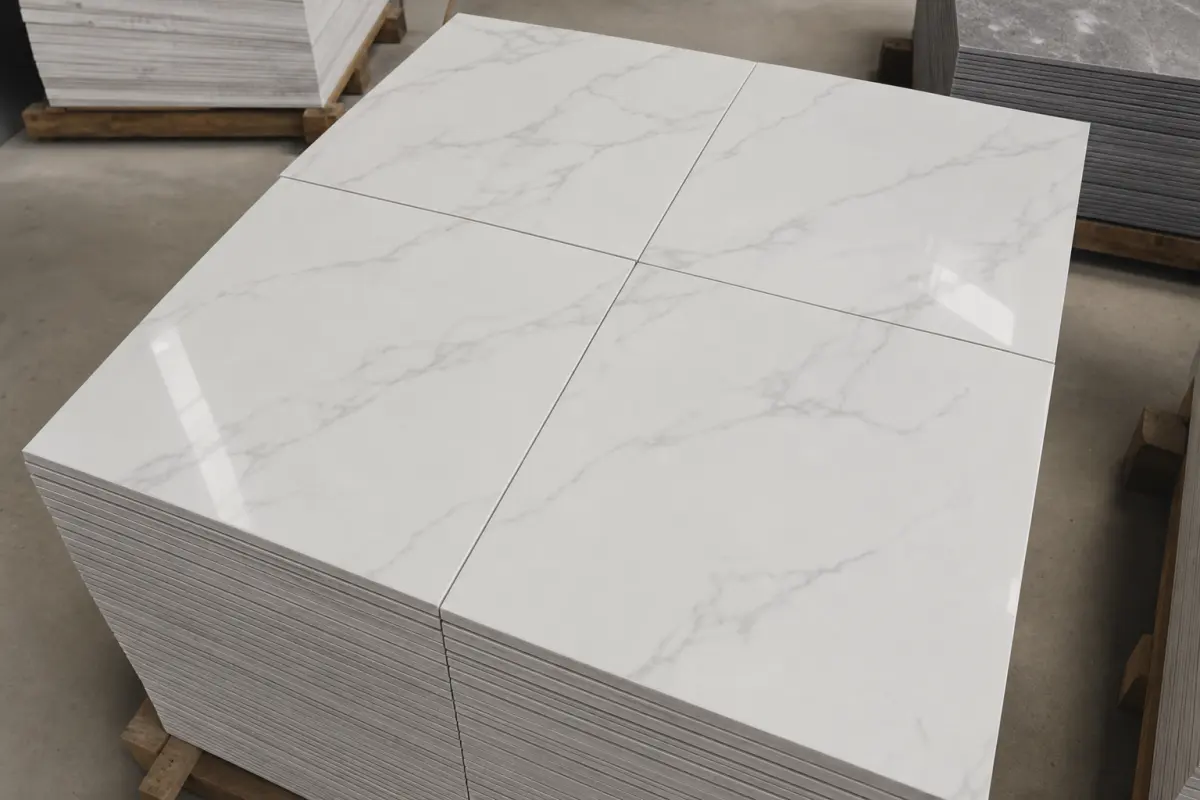
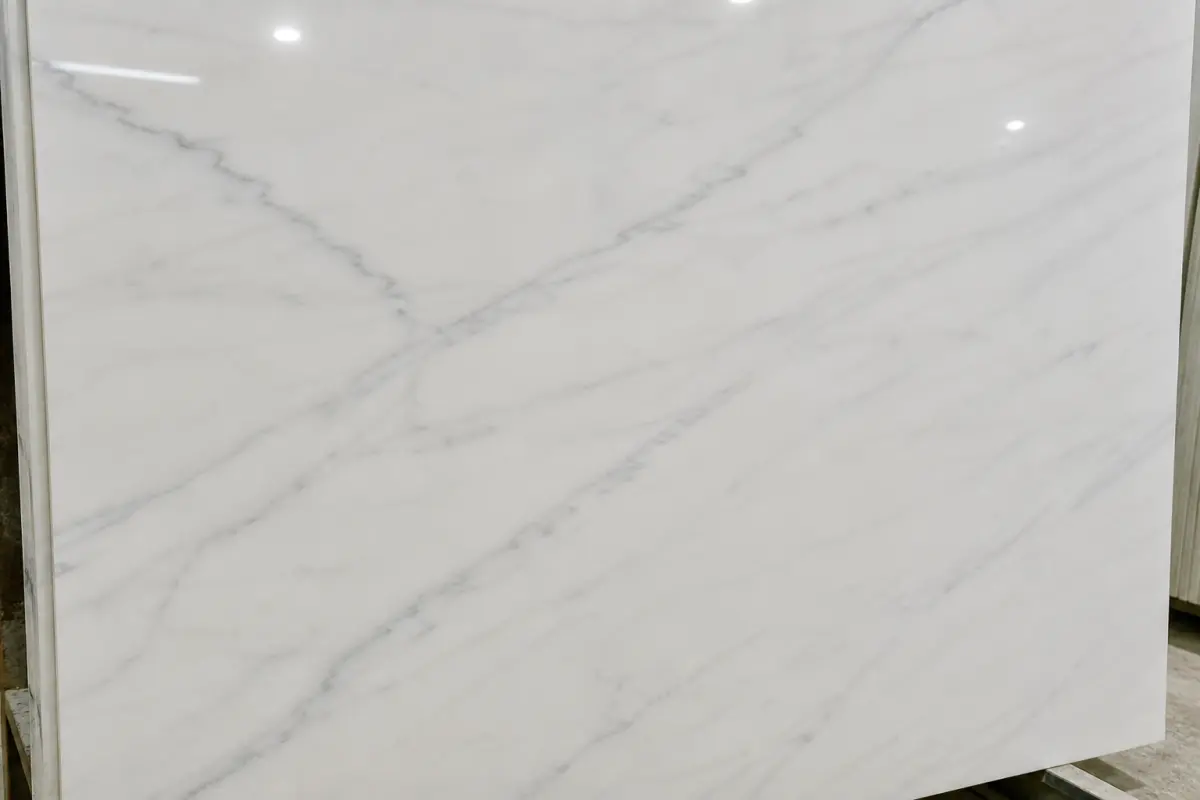
Bampokha No.1 is the default export white many Gulf yards already understand. Super White is the brighter bin. They must be separate lines. A mosque that approved Bampokha must not receive Super White “as an upgrade” without a new mock-up—the vein and brightness shift is visible in prayer-hall lighting. Start from Bampokha No.1 slabs or Super White, not from “Pakistan white.” Tiles for courtyards, wudhu areas, or back-of-house may be 60×60 Buner white from the same lot if you say so.
Black, grey, and onyx are accents. Nanser-type black vanities against a white hall are a second SKU with a second lot. Do not let a mill fill leftover black into a white mosque container. Feature onyx is a lighting design conversation. Keep the field stone boring and documented.
Mosque scale: shade lots, not hero slabs
A hall of 2,000 m² is not twenty pretty photographs. It is a lot: named blocks, numbered bundles, a fence of approved and rejected slabs, and a written rule for what happens when the mill runs out of that bench. Write attic stock—extra metres of the same lot for future repair. Mosques get repaired. A different white in year four is a visible scar.
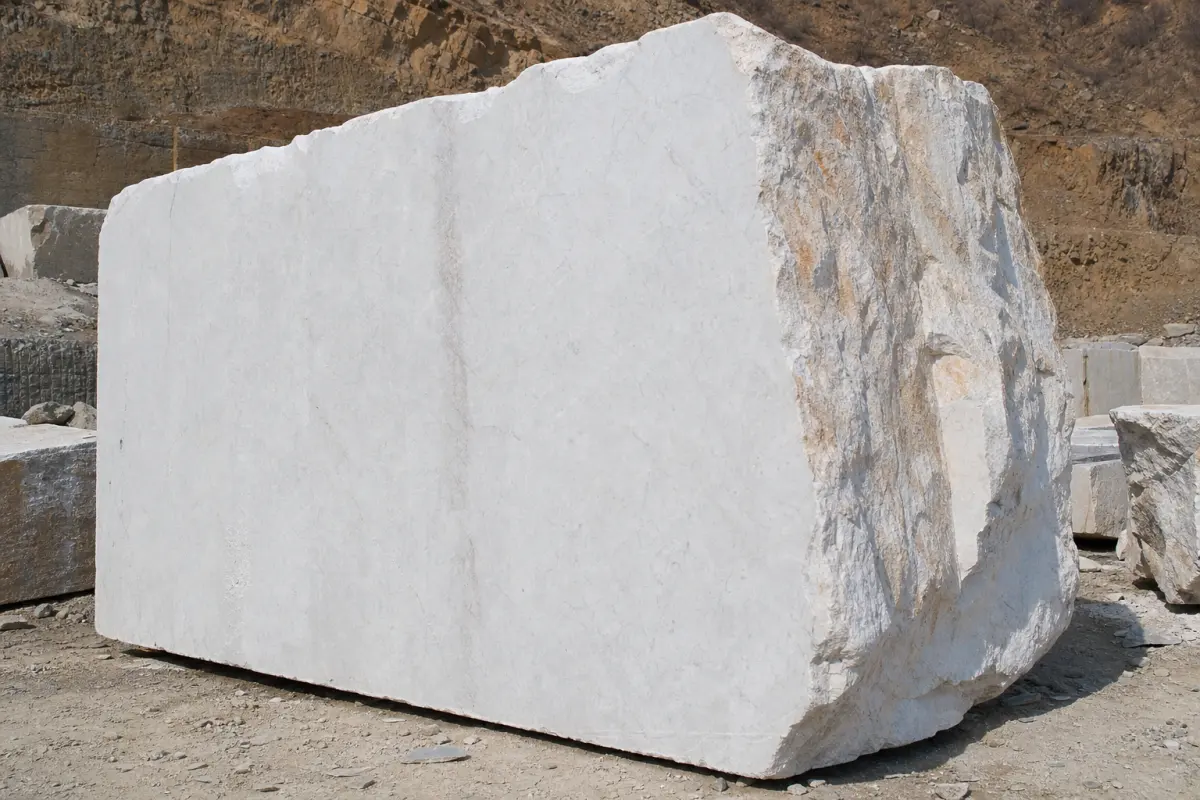
Honed versus polished: some halls want less glare. Say it. Thickness: 2 cm is common; 3 cm appears in stairs and some floors. Wet zones need resin and mesh stated. Bookmatch is rarely the field; it may be a mihrab wall. If you want bookmatch, you want wire-sawn blocks and sequential numbering. Blasted leftovers will not pair. Method background: blasting versus wire saw.
Lighting in a mosque is not a Dubai villa LED strip. Approve samples in a large room, preferably with the lighting consultant. Photograph wet and dry. Grey veins that look “character” on a phone can look dirty in a white hall. Commercial grade that looked cheap on a yard can look honest at scale if the lot is even. Evenness beats peak brightness for large floors.
Villa compounds: repeat houses, one stone story
Compounds fail when house 12 does not match house 3. Freeze a lot for the compound, not per villa. If phasing is yearly, either buy attic stock or accept a new approval. Designers in Riyadh and Jeddah will not remember your mill’s “same as last year” claim. Keep chips in a labelled box in the contractor’s office.
Wet areas in villas are where cheap fill shows. Write mesh and resin. Exterior steps and unshaded courtyards are where marble etches; consider honed, sealer, or a harder stone outside. Interior Bampokha with exterior granite is an adult specification. Selling polished marble as a fountain surround without a maintenance note is how snagging lists get ugly.
Kitchen islands in 2 cm need fabricator input on support. UAE and Saudi fabricators know this; mills in Buner may still think only in slabs. Put finished-size minimums on the RFQ if the island drawing is already done. Short slabs waste. Jumbo promises from small benches waste time.
Commercial fit-out: lobbies, malls, and FF&E packages
Lobbies want the hotel discipline: mock-up, lot lock, repeat PO language. Malls want even commercial grades at quantity. FF&E packages that also run in Dubai or Doha should still treat Saudi as its own lighting and approval, then share mill and lot IDs if the designer agrees. Northern Pakistan hotel supply at a category level is hotel and commercial marble; GCC chain behaviour is GCC hotel marble from Buner. This page is Saudi project geography and mosque/villa scale.
Calibrated tiles for large floor plates need a mill that actually calibrates. Subcontracted tile lines must be named. Snagging on lippage is more expensive than a factory visit. If the consultant specified 60×60 rectified, say rectified. “Tile like the slab” is not a calibre.
Stair packages in 3 cm should be a line item. Mixing leftover 2 cm in a stair crate is a safety and snagging issue. Write thicknesses per use. Black contrast treads are a second stone. Keep packing lists literate.
Dammam, Jeddah, Riyadh: three logistics stories
Marble from Pakistan to Saudi still starts at Karachi or Port Qasim. It does not start at Dammam. The mill in Swari does not know your inland Saudi trucker. Split the file: mill produces FOB Karachi (or CIF a Saudi port if a real forwarder priced it); Saudi importer owns discharge, SASO/SABER filings as required, and inland to site. Asking a Buner factory to “deliver Riyadh site” is how numbers become fiction.
Dammam often suits central and eastern projects. Jeddah suits western. Riyadh is inland from both. Your forwarder picks the port; you put the destination city on the RFQ so packing and crate counts can be planned. Ocean is short relative to Far East. Inland Saudi can dwarf ocean if the site is a remote compound. Budget it. Do not hide it in the mill’s FOB.
Incoterms: force FOB Karachi for mill comparison, then add ocean. CIF Dammam/Jeddah is fine when the exporter’s forwarder is real—get the booking note. The KPK Incoterm map is FOB Karachi from KPK factories. Identity of who files Pakistani export docs is Pakistan marble exporter from KPK. Saudi import compliance is your importer’s file.
Import compliance without fake certificate theatre
Saudi import of building materials involves rules that change. SASO, SABER, and related platforms are administered for a reason. Your licensed Saudi importer and customs broker own that process. A Buner mill cannot honestly “include SASO” as a WhatsApp extra. What the mill can do is describe the goods accurately, provide invoices and packing lists that match crates, and support test reports if a specific laboratory test was contracted.
If a consultant requires a water-absorption or flexural test, contract a lab and sample from the lot—not from a hero slab. Do not accept a generic PDF with a mill logo as a test. Do not publish invented certificate numbers in marketing. This article will not pretend to be a 2026 SABER walkthrough. It will tell you to budget broker time and not to let a mill’s confidence replace a licence.
Wood packing may need treatment for destination rules. ISPM marks on crates are a mill or packer task when required. Write it if your broker says it is required. A-frames that leave Torwarsak unmarked can be a problem at discharge. Ask once, in writing.
Who should saw a Saudi-scale white programme
A trader with three photos cannot. You need a mill (or two named mills) with gangsaw depth, polish capacity, and a yard that can hold a frozen lot. Manufacturer versus trader tests are in manufacturers versus traders. Factory-direct playbooks are in Buner marble supplier. For Saudi scale, add: night-shift reality under PESCO, ability to photograph every crate, and willingness to keep attic stock.
Two mills can be rational: one for field white, one for black vanities. Name both. One exporter of record can still file the GD if you want a single seller—disclosed split. Silent splits are how mosque halls get two whites. Profiles like Zeex Naturals and Ayaz Marble that declare Buner processing are a starting shortlist, not an exclusive. Publish the RFQ on the marketplace and let capacity answer.
Visit if the metreage is mosque-scale. Peshawar to Torwarsak is cheaper than a snagging war in Riyadh. Take the lighting consultant’s photos. Reject in the yard. If you cannot fly, pay an inspector at mill gate and at Karachi stuffing. First containers of a mosque lot are not the place to save the inspector’s fee.
Payment, milestones, and political patience
Saudi importers sometimes pay on documents because their own clients pay slow. Mills in Buner still need deposits to buy blocks and blades. Write milestones that both can live with. Letters of credit work when the exporter’s name is real. Third-party accounts do not. Scam patterns do not respect the holiness of the end use—read buyer protection.
Lead times must include power. Summer load shedding stretches polish. Do not promise a national-day opening on a June RFQ without a buffer. Electricity is documented in the Buner electricity note. Tax-compliant invoices matter for banks; the tax research is the background.
Retention after installation should relate to documented defects, not to a client’s mood. Shade outside the approved fence is a mill issue if photos exist. Shade inside the fence that a site team dislikes is a design issue. Keep the fence.
RFQ language a Buner mill can price for Saudi
Origin, commercial name, selection, thickness, finish, resin/mesh, quantity plus attic stock, crate standard, FOB Karachi, destination city in Saudi, inspection rights, lot-lock photos, FBR invoice. Attach mosque or villa drawings if sizes are constrained. Attach three approved and three rejected photos. Separate SKUs for tiles, black, grey. That is enough for a Torwarsak owner to say yes or no. More poetry does not help.
Copy the RFQ structure from marble RFQ on a B2B marketplace. Online buying caution from buy marble from Pakistan online. Dubai stock habits from UAE importers if your Saudi project is actually being purchased through a Dubai yard—then lot-lock anyway, because a yard leftover is not a mosque hall.
Saudi fabricators versus mill-finished slabs
Riyadh and Jeddah fabricators can take 2 cm Buner slabs and produce stairs, cladding, and cut-to-size if the slab sizes are honest. They cannot invent length the mill did not saw. If the drawing needs 300 cm clear, the mill RFQ must say 300 cm clear after trim. Importing finished cut-to-size from Buner is a different product: more labour in Torwarsak, more breakage risk, tighter packing. Most Saudi programmes still import slabs and finish locally. Write which path you are on. Do not assume a mill quoting slabs is quoting your island drawing.
Local fabrication also means local snagging. A mill in Buner cannot fly in to polish a lip. Keep attic stock of the same lot so a damaged stair can be recut. Five to ten percent extra on a mosque hall is cheaper than a visible patch. Compounds should store labelled crates, not a pile of “leftover white.” Leftover without a lot ID is how house 18 gets a different floor.
If the consultant specified Italian names in the concept and the client value-engineered to Pakistani white, document the substitution with a signed sample. Site teams that still have “Carrara” on the drawing will reject valid Bampokha. That fight is not the mill’s geology. It is your paperwork. Put the approved commercial name on the drawing revision, the BOQ, and the mill RFQ so all three match.
Buner marble for Saudi Arabia works when the hall, the compound, and the lobby are treated as industrial lots from a named mill, not as a spiritual shortcut to cheap white. Specify Bampokha or Super White. Freeze the lot. File Saudi compliance with people who are licensed to file it. Use StoneVaults to put the mill on the same RFQ as the metreage. If you need a hand attaching a BOQ, contact the desk—bring the drawing, not a mood.