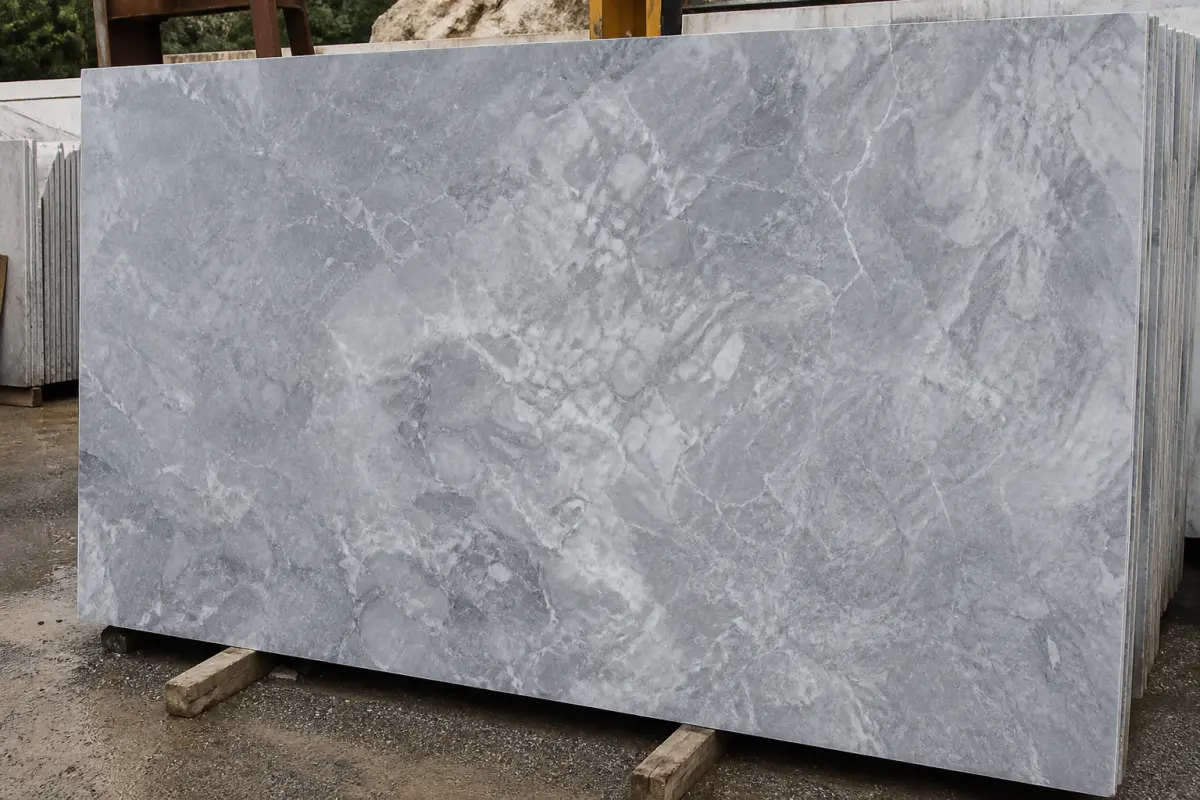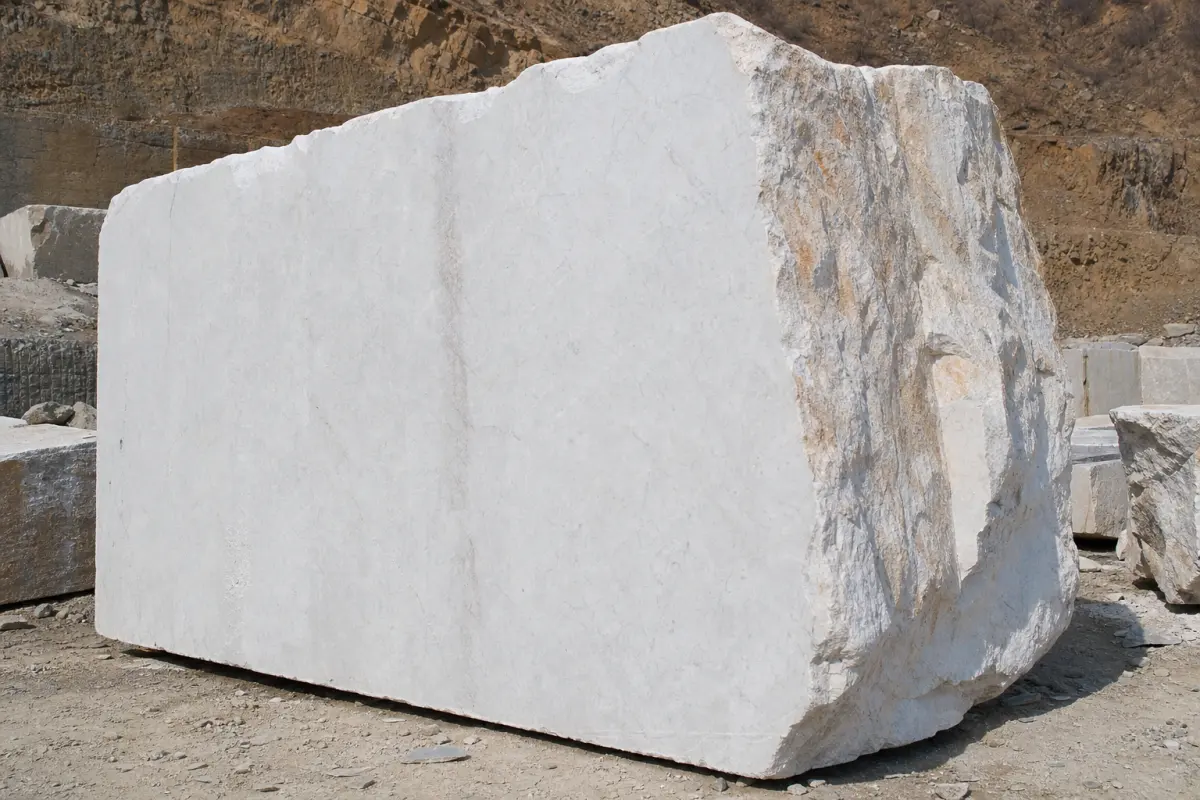
Google “marble manufacturers Pakistan” and you will meet Karachi letterheads. This guide separates Buner factories that own gangsaws from traders and brokers, using mill video, NTN, block yards, and night-shift power as proof.
Search marble manufacturers Pakistan and the first page is rarely a gangsaw. It is a Karachi office, a Saddar showroom, or a trade-directory ghost with a Hotmail address and a stock photo of Carrara. Some of those offices are honest exporters. Many are traders. A few are brokers with a phone and someone else’s mill. If you need a factory in Buner to saw your thickness this month, you have to tell those three apart before you wire a deposit. This article is that distinction—not a moral ranking. Traders can be useful. Brokers can be fine for a sample. Only a manufacturer will put your block on a blade they own.
Buner still hosts the densest processing cluster in Malakand Division: on the order of five hundred mills out of roughly seven hundred in the division, along valley roads through Torwarsak, Swari, Elai, and the approaches toward Chamla. That density is why “marble factory KPK” is a real sourcing strategy and also why impersonation is easy. Walk the same road and you will see saw sheds, polish job shops, and trader offices within a kilometre. Google does not know which door owns the crane. You have to ask for proof that maps onto the Torwarsak and Swari factory map and the wider Buner quarry-direct supplier guide.
Manufacturer: owns blade time, not only a letterhead
A manufacturer in this trade is the party that controls primary sawing. Typical signs: a gangsaw or wire-saw hall, a block yard with numbered stones, a polish line or a documented job-shop next door, labour on a night shift when PESCO returns power, and an NTN that matches the mill’s invoice. They can tell you which feeder they sit on. They can show you the block they intend to cut for your PO. They may still buy blocks from a lease holder rather than owning the quarry. Mine-direct and factory-direct are different claims. Manufacturer means factory-direct on the saw, not necessarily lease-direct on the hill.
Integrated manufacturers saw, resin-treat where needed, polish, and pack. Saw-only manufacturers sell half-slabs to polish job shops in Swari or Maskini. Both are manufacturers. The saw-only unit is not a trader. You must know which one you hired, because a saw-only quote for “polished 2 cm” is a subcontract you have not priced. Ask: do you polish in this shed, or do you send out? A clear answer is competence. A vague answer is a trader borrowing a mill’s name.
Manufacturers are slower on English PDFs and faster on millimetres. They will haggle thickness before they haggle brand stories. They will object to a fourteen-day promise in a load-shedding month. That objection is a manufacturer tell. A broker promises the date and phones three sheds. Factory-direct buying habits are expanded in the Buner factory-direct guide; here the test is identity, not the full commercial playbook.
Trader: inventory, relationships, and a margin you can see
A trader buys from mills, holds or allocates stock, and sells to you. In Mingora, Peshawar, and Karachi this is a normal business. A good trader discloses the mill, shows bundle photos from that mill, and issues an invoice that matches the goods. A bad trader hides the mill so you cannot go around them next time. Hiding is not illegal. It is a cost. Price the opacity.
Traders earn their margin when they consolidate half-containers, hold shade lots, speak LC language, or sit next to a port. They do not earn it by claiming “our factory in Buner” if the factory is a supplier they met last year. Ask a trader for the mill’s union-council name and a video pan from gangsaw to the bundle with your mark. If they can produce it within a day, they have a real relationship. If they stall, you are the relationship, and the mill does not know you exist—which means your deposit sits with the wrong party when something slips.
Some traders own a small polish line and buy sawn slabs. Call them finishers, not manufacturers, unless they also own the gangsaw. Finishers matter for cut-to-size and tile calibre. They do not control block selection at the face. If shade continuity across containers is your risk, you want the saw, not only the last head on the polish line.
Broker: access without inventory
A broker introduces. They may be a nephew in Dubai, a WhatsApp admin in a marble group, or a Karachi fixer who “knows all the factories.” Brokers are not automatically scams. They become a problem when they take a manufacturer deposit into a personal account, or when they re-trade your RFQ to five mills and sell the cheapest screenshot as their factory. If the person quoting cannot show a yard, a crate, or an NTN tied to the goods, treat them as a broker and cap what they hold.
Never let a broker be the only party who knows the mill GPS. Once your first container is awarded, get mill contacts on the PI even if the broker stays in the deal for language or collection. Buyer-protection patterns—fake factories, recycled photos, pressure deposits—are covered in the scams article. This page only needs the identity test: if they cannot prove a saw, they cannot be paid as if they owned one.
Proof that survives a video call
Gangsaw video. Ask for a live pan, not a file from 2019. You want the hall, the moving blade or wire, the operator, and a walk to the bundle or block they say is yours. A still photo of a machine with no context is catalogue. A live call that starts in a Karachi office and never reaches Buner is a trader tour. Manufacturers complain about video; they still do it for a serious PO. Refusal after you have shared a real spec is a stop.
NTN and invoice identity. The name on the quote, the NTN on the tax invoice, and the mill gate should be reconcilable. Post-PATA sales tax on industrial supplies made fake “tax-free mill” stories more expensive to maintain. A manufacturer who will invoice under their NTN is in the formal stack, which is what your bank wanted anyway. Tax mechanics are in the Buner factory tax research; commercially, you only need the same legal name on PI and invoice.
Block yard. Manufacturers have stones with paint marks and a crane. Traders may have a godown of polished slabs. Brokers have JPEGs. Ask to see the raw blocks they will saw, with dimensions. If the yard is empty and the quote is for a full container next week, they are buying from someone else—fine, if disclosed as trader terms.
Night-shift power. This is a Buner-specific tell. Mills on mixed or high-loss PESCO feeders often saw when voltage returns at night. A manufacturer can talk about last month’s productive hours, diesel, and whether your lot is grid-sawn or generator-sawn. A Karachi office reciting “no problem, twenty-four hour factory” has not paid that bill. Electricity research explains why hours vanish; as a buyer, treat detailed power talk as evidence the speaker runs a mill. Empty confidence is a trader script. See load shedding in Buner marble factories if you need the feeder background before the call.
Why Google ranks Karachi offices as “marble manufacturers Pakistan”
Karachi exporters invested in English websites, Alibaba ads, and directory listings for two decades. Buner mill owners invested in blades. Search engines reward the first group. The office in Saddar or Hub may well ship excellent Buner stone. It is still not a Buner manufacturer unless it owns or controls the saw. Many search results are trading companies that buy from Torwarsak and polish the story, not the slab.
Directory pages freeze dead mills. Units close on power and demand; the listing stays. Thin directories are a known buyer trap. Prefer live inventory and dated photos over a 2018 “factory profile.” The KP supplier vetting checklist is the longer diligence list; the short version is: mill video, NTN, yard, hours. If a Google result cannot survive those four, it is a lead, not a manufacturer.
Islamabad finishing yards and Peshawar godowns create a second confusion. A company may manufacture some SKUs (cut-to-size, tiles) in the city and trade Buner slabs for the rest. Read the profile. AYAZ MARBLE and other KPK listings on StoneVaults should be judged by what they publish—factory location, quarry location, and product photos—not by the word “manufacturer” in a meta title. The directory at /suppliers exists so you compare profiles side by side instead of trusting a search snippet.
How to use Torwarsak and Swari without getting lost
Torwarsak is the name buyers hear because the factory row is visible from the road: frames, slurry, block stacks. Swari is the processing neighbour with its own sheds and family groups that operate in both places. Neither village is a company. “We are in Torwarsak” is a geography claim. Ask which lane, whose crane, whose blade. The supplier map article is the walking guide. This article only needs you to treat a village name as a starting pin, not as proof of manufacture.
Chamla and Chagharzai material, Nanser blacks, and Bampokha whites all meet the same saws. A manufacturer who cannot name the quarry family of the block on the yard is either careless or trading. Careless mills still cut well; they will not hold shade across a hotel repeat PO. Ask for the paint mark and the lease-area name before the saw starts. You are not accusing them of fraud. You are writing the bundle map.
Elai and Maskini sit in the same district conversation as job-shop finishing: vanity tops, mosque panels, cut-to-size that a primary gangsaw does not want to stop for. Those sheds can be manufacturers of the piece they are cutting today and still be traders of the white slab they showed you on the phone. Ask which machine will run your PO. If the answer is “we will send it to Torwarsak,” you have a finisher with a subcontract. Price the subcontract or walk to the saw yourself. Village clusters are not org charts.
Site visits remain the gold standard for large programmes. If you cannot fly, pay for a third-party inspector who starts at the gangsaw, not at a Mingora hotel lobby with samples on a table. Samples on a table prove a trader has friends. Samples next to a numbered block prove a manufacturer has inventory.
When you should still buy from a trader
Buy from a trader when you need one mixed container, LC-fluent documents, or a port counterparty and you do not want to staff Malakand logistics. Buy from a trader when the mill you like will not export in its own name. Buy from a trader when they lock a named mill and a named shade lot in writing. Do not buy from a trader who insists the mill is a secret “for your protection.” That protection is theirs.
Brokers can source a sample pack or open a first conversation. Convert them to a disclosed mill before production money moves. If they cannot convert, they did not have a mill. The marketplace is useful here: manufacturers who list SKUs have already chosen to be visible. Brokers who only exist in chat will underperform that test.
Identity checklist before the deposit
- Live video: gangsaw hall, then block yard, then the bundle or block for your PO.
- Written mill location: union council / village, not only “Buner.”
- NTN and legal name matching the PI.
- Statement: we saw / we polish / we trade / we broker—one or more, declared.
- Power: last month’s productive hours or an admission of night-shift sawing.
- Quarry family of the block: Bampokha, Nanser, Chamla, or other—named.
- Who will be shipper if the term is FOB.
Seven yeses and you are talking to someone who can saw or someone honest about not sawing. Either is workable. A smile and a Google ranking are not.
Frequently asked questions
Is a mill that rents blade time a manufacturer?
If they control the job on a named machine and can show it, treat them as a manufacturer for that PO. If they “will arrange a factory,” treat them as a trader. Control on the day of sawing is the test.
Can a Karachi company be a Buner manufacturer?
Only if it owns or operates the Buner mill, not merely buys from it. Dual presence is common: mill in Swari, sales desk in Karachi. Demand the mill video anyway. The desk does not cut stone.
Do manufacturers on StoneVaults skip this proof?
No. A verified profile means the company passed platform KYB. It does not replace gangsaw video on a first container. Use the profile to shortlist, then run the identity tests on the winning mill.
What if two bidders show the same shed?
Then at least one is a trader or broker on that mill. Ask the mill who is authorised to take deposits. Pay the authorised party. Do not pay both “to be safe.”
Marble manufacturers in Buner are not hiding. They are busy, often under-powered, and uninterested in your SEO. Traders and brokers fill the English-language gap Google loves. Your job is not to avoid traders. It is to know who will saw the order, who will invoice it, and who will only forward a photo. Once those roles are named, Buner’s factory belt is usable. Until they are named, you are buying a search result.