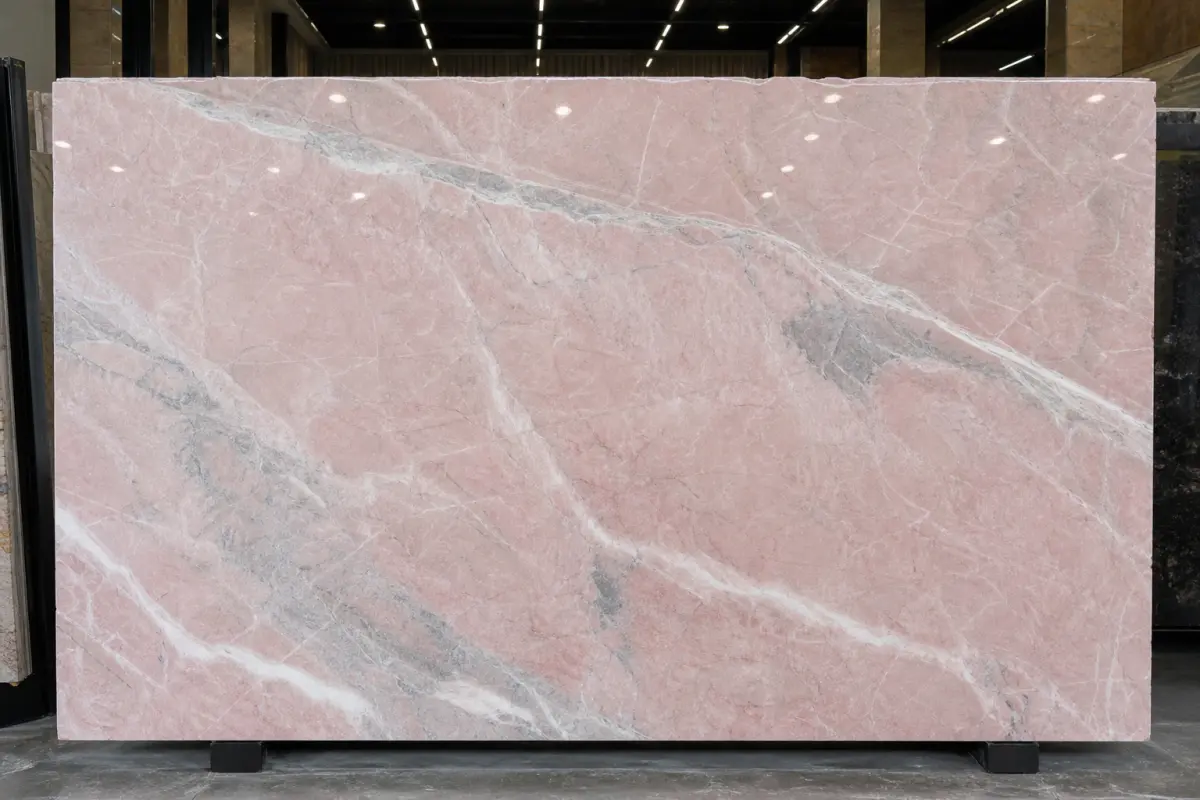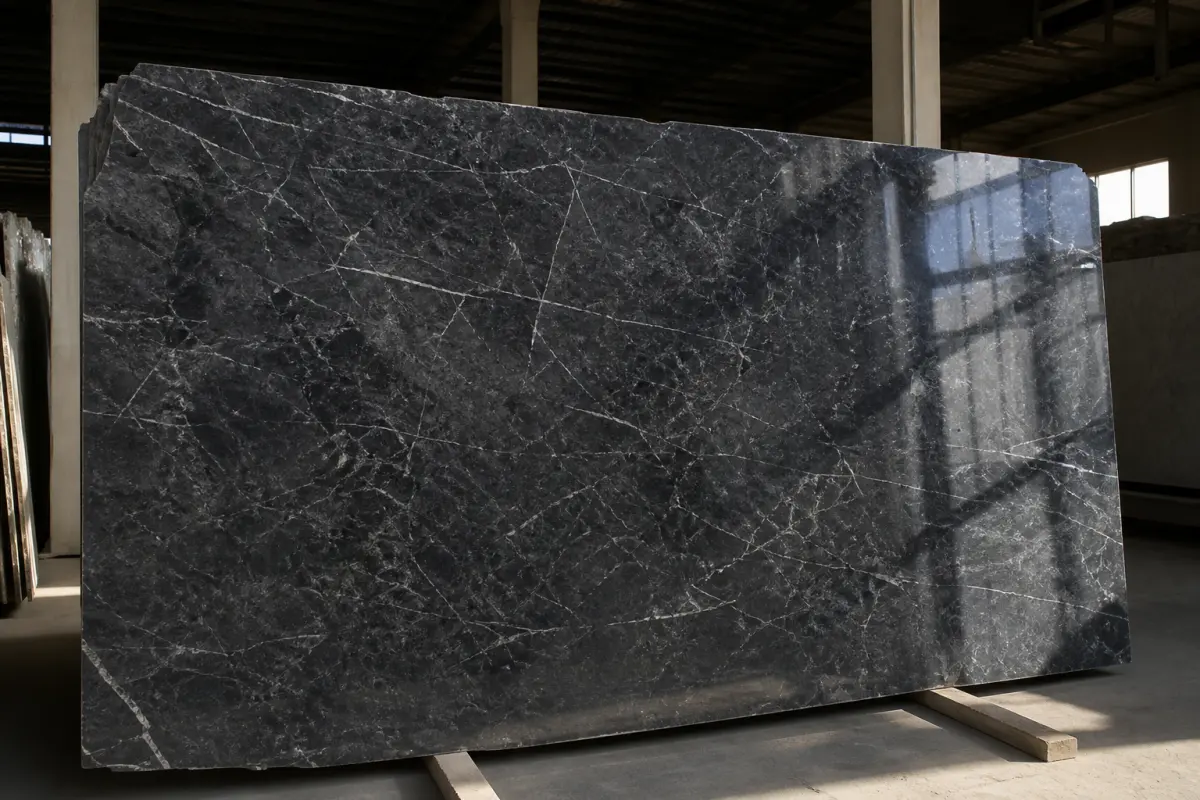
FOB Karachi marble from a Buner mill is not the same contract as ex-mill Swari or CIF Jebel Ali. This guide assigns trucking, packing, breakage, and shipper identity so KPK factories and Gulf buyers stop arguing about a gap neither quoted.
FOB Karachi marble is the Incoterm Gulf buyers type into a PI as if it were a factory gate in Swari. It is not. Between a gangsaw in Buner and a vessel at Karachi Port or Port Qasim sits a mountain-to-port gap: inland trucking, export packing, stuffing, terminal handling, and a shipper name on the bill of lading. Someone pays each of those lines. If the PI does not say who, the mill thinks you did, and you think the mill did. The stone still moves. The argument starts when a crate splits on the Indus highway or when the forwarder asks who is the exporter of record.
This article is commercial terms and cost ownership. The physical route—roads, seasons, crate physics—is the companion piece on quarry-to-Karachi logistics. Wholesale container habits live in the MOQ and Incoterms guide. Document sets live in exporting marble from Pakistan. Read those for how cargo moves and what papers travel with it. Read this for who owns the rupee when a KPK factory says “FOB” and means something milder.
Three terms in language a Buner mill actually uses
Ex-mill Swari / EXW Torwarsak means the mill’s job ends at its own gate, or at the loading bay beside the polish line. You own the truck, the driver, the tarpaulin, the breakage after the gate, the Karachi yard, the customs agent, and the ocean. The mill owns thickness, polish, and a packing list if you paid for crates. Many family factories prefer this term because they have never been the exporter of record and do not want to learn HS codes on your deadline. The quote looks cheap because the mountain-to-port gap is invisible.
FOB Karachi (or FOB Port Qasim—name the port) means, in Incoterms logic, the seller delivers the goods on board the vessel nominated by the buyer, export-cleared. In Buner practice, “FOB” is often used more loosely: mill delivers packed cargo to a Karachi stuffing yard or dry-port godown, and a forwarder finishes the rest. That looseness is the whole problem. A true FOB quote from a mill that actually exports includes inland freight, export packing to a marine standard, export clearance, and delivery to the ship’s rail or to the agreed onboard point. A fake FOB quote is ex-mill plus a friend’s truck, with you still paying THC, documentation, and anyone who will put their name as shipper.
CIF Jebel Ali (or CIF Dammam, Hamad, Shuwaikh) means the seller also arranges ocean freight and minimum insurance to the named destination port. Cost, insurance, and freight sit with the seller until the port of discharge; risk typically transfers earlier, at shipment, unless you contract otherwise. CIF is convenient when you do not have a freight contract. It is opaque when the mill’s cousin books the cheapest vessel and the cheapest cover. Demand the freight inclusion list: ocean, BAF, documentation, and which insurance clause. A CIF number without a vessel window is a wish.
Who pays for trucking from Buner to Karachi
The inland haul is the expensive quiet line. Marble leaves Torwarsak, Swari, Elai, or a Chamla-facing mill and runs south through Mardan and the Punjab motorway network toward Karachi. Transit is measured in days, not hours. Fuel, weighbridge, overnight stops, and checkpoint time sit inside that day-count. On EXW, you pay the trucker directly or through your forwarder. On honest FOB, the mill or its appointed carrier pays and builds it into the square-metre rate. On CIF, inland is inside the seller’s stack before ocean even starts.
Do not assume the mill’s “we will send to Karachi” is FOB. Sending is not delivering export-cleared on board. Ask: who books the truck, whose insurance is on the cargo during the haul, and at which Karachi gate title and risk are supposed to move. If the mill cannot name the stuffing yard, you are still on a handshake EXW with a courtesy lift. Courtesy lifts disappear when a trailer jackknifes.
Power cuts change trucking cost without changing the Incoterm. A mill that finishes polish three days late still occupies a trucker who was booked against a vessel cut-off. Detention and roll fees are not “logistics colour.” They are whose calendar slipped. Put a production-complete date and a latest gate-in date on the PI, and state who pays if mill delay misses the ship. Load-shedding context is in the district electricity research; commercially, you only need the delay clause so FOB Karachi does not become an open-ended inland hotel bill.
Packing, stuffing, and the marine crate you thought was included
Ex-mill packing in Buner is often domestic: slabs strapped for a Pakistani site truck, not for a summer haul plus a container stack. Marine packing is A-frames or closed crates, corner protection, moisture barriers where specified, and timber that can take an ISPM-15 stamp if the destination requires it. Those materials and that labour are a cost line. If your FOB quote used the mill’s domestic pack, you will pay again at the Karachi yard when the forwarder refuses to stuff what will not survive the voyage.
Stuffing is a separate act from packing. A mill can crate at Swari and still leave stuffing to a Karachi depot. Who pays the depot, the labour, and the wait in port congestion must be on the PI. FOB that stops at “delivered to yard” is not FOB. It is FCA or worse, dressed in a term buyers recognise. Name the stuffing point. Photograph crate IDs at mill gate and again at stuffing. The two photo sets are how you decide whether inland breakage is mill risk or carrier risk.
Blocks follow different packing physics. A Bampokha raw block moves on chocks and chain, not in an A-frame. Browse raw block listings with Incoterms that match block reality: many China-bound programmes are FOB Karachi on weight, not on square metres. Do not copy a slab FOB clause onto a block PI. The mountain-to-port gap is the same road; the failure mode is a shifted block, not a chipped polished corner.
Breakage: who owns the cracked slab
Marble breaks on the road, at stuffing, and in the cell. Incoterms allocate risk at defined points; they do not automatically pay for replacement stone. Write a breakage clause that matches the term you chose. Under EXW, once the mill loads at its gate (or even before, if loading is your job), inland breakage is typically yours unless negligence at the mill is proven. Under FOB, inland plus export handling is generally seller risk until the onboard point—if the seller actually contracted FOB rather than a courtesy drop at a godown. Under CIF, seller insurance should respond to marine casualties per the policy; inland still needs its own cover if the seller’s policy starts at the port.
Practice in the Buner–Karachi trade is messier. Truckers are weakly insured. Mills will replace a factory-gate chip they photographed and will fight a Karachi-yard chip they did not. Buyers who skip pre-shipment photos lose. Put replacement thresholds in writing: corner chips on lobby-grade Bampokha No.1 versus commercial grey that will sit under furniture. Feature blacks and onyx need a stricter pack and a stricter clause; a Nanser-area black slab that travels like a commodity white is how CIF claims begin.
Insurance is not the Incoterm. CIF includes a minimum cover the seller buys; FOB and EXW include none unless you add it. Many importers buy their own cargo policy from mill gate regardless of term, because mill-arranged cover can be thin. That is rational. Just do not double-pay: if you insisted on CIF, audit the seller’s certificate instead of silently buying a second policy and still arguing about deductibles.
Who is the shipper on the bill of lading
This is the clause that surprises first-time buyers of Pakistan marble FOB from a hill mill. The shipper on the B/L is the party the carrier recognises as delivering the cargo for export. Many Torwarsak factories cannot or will not be that party. They have an NTN and a mill, not an export department. A Karachi trader, a freight forwarder acting as agent, or a related export company becomes shipper. That is legitimate if disclosed. It is a problem if you thought you were buying factory-direct FOB and the B/L shows a third company you have never vetted.
Ask on the RFQ: who will appear as shipper, consignee, and notify party. Ask who signs the export declaration. Ask whether the mill’s invoice value will match the export value the bank sees. Mismatches delay letters of credit and invite customs questions at both ends. The geography choice—KP mill versus Karachi house—is discussed in local KP suppliers versus Karachi exporters. The commercial point here is narrower: FOB Karachi from a KPK factory is only factory-direct if the mill (or its named export nominee) is actually on the documents.
If the mill wants to stay EXW and you want FOB, hire your own forwarder and let the mill deliver to that forwarder’s Karachi yard under a named FCA. You keep mill identity on the commercial invoice and put the forwarder’s export process on a separate fee. Hybrid is how a lot of serious Gulf programmes already run. Pretending the mill is Maersk is how shipper names go missing until cut-off day. Exporter-role context for KPK names sits in Pakistan marble exporter from KPK; use it when you are shortlisting who can honestly be shipper.
Why a cheap ex-mill quote loses to a dearer FOB
Work a simple stack, not a fantasy freight. Ex-mill Swari for a white slab lot looks attractive until you add: marine crates, inland truck, Karachi yard and stuffing, export clearance, THC, and your time chasing a mill that does not answer the forwarder. A mill that already exports FOB has those numbers in muscle memory. Their square-metre rate is higher because the gap is inside it. Your landed cost may still be lower than EXW plus amateur inland, especially on a first container when you do not have a nominated trucker in Malakand.
CIF Jebel Ali can look even simpler and still lose. If the mill’s ocean rate is stale, or if they booked a service with a long dwell, your site date slips. Hotel opening dates do not care that CIF was “easier.” Sophisticated buyers often take FOB Karachi with their own freight contract, keep the mill responsible to the onboard point, and stop there. That split is the cleanest reading of marble export Karachi Buner for repeat programmes.
Tax treatment must match the term. An EXW invoice may be a domestic supply. An export FOB invoice has a different documentation trail. If your bank needs an export commercial invoice and the mill only issues a local mill bill, FOB was theatre. Align invoice type with Incoterm before production starts, not at stuffing.
Contract language that belongs on the PI
Write the Incoterm in full: term, named place, Incoterms year if you care about the official text. Write the stuffing point and the onboard port as two places if they differ. Write who books the truck. Write who is shipper. Write the pack spec. Write the photo protocol at mill gate and at Karachi. Write who pays if the mill misses the gate-in date, and who pays if the vessel rolls after cargo was on time. Write the breakage replacement rule. None of this is exotic. It is the mountain-to-port gap in sentences.
Payment milestones should follow cost ownership. Deposit against saw start is mill cash. A tranche against packing photos at the mill protects you before the inland haul. Balance against onboard documents matches FOB. If you paid 90 percent at mill gate on a FOB contract, you financed the mill’s inland risk with your money. Reverse it only when you have history with that shed.
Publish the same term on every bid you collect on the Pakistan marketplace. A table of EXW, “FOB,” and CIF without normalisation is how procurement awards the wrong mill. Ask suppliers to declare whether they have stuffed at Karachi in the last twelve months. A mill that has never seen Port Qasim can still make excellent slabs. It should not pretend to be your carrier.
A worked ownership map
- EXW Swari: mill — stone and (optional) domestic pack. Buyer — truck, marine pack if not bought, stuffing, export clearance, ocean, insurance, shipper nomination.
- FCA Karachi yard: mill — stone, marine pack, inland to named yard. Buyer — stuffing if not included, export clearance if not included, ocean, insurance, often shipper via forwarder.
- FOB Karachi / Port Qasim: mill or mill’s exporter — through onboard. Buyer — ocean, usually insurance, destination clearance.
- CIF Jebel Ali: seller — through freight and minimum insurance to discharge port. Buyer — destination clearance, on-carriage, and any cover above the seller’s policy.
If a quote cannot be dropped onto one of those four rows, it is not a term. It is a WhatsApp promise. Send it back.
Frequently asked questions
Can a Swari mill quote true FOB if it has no Karachi office?
Yes, if it has a standing forwarder or export nominee and has actually shipped. No, if “FOB” means a relative with a truck. Ask for the last bill of lading shipper name (redacted) and the stuffing yard. Silence means EXW with optimism.
Is Port Qasim the same as Karachi for FOB?
No. Terminals, congestion, and forwarder habits differ. Name the port. Do not let “FOB Karachi” float between Keamari and Qasim while THC changes.
Who pays detention if load shedding delays polish?
Whoever owned the calendar. If the mill committed a gate-in date on a FOB PI, mill delay is mill cost unless the PI gave a power buffer you accepted. Write the buffer. Do not discover it in a voice note.
Should I ever buy CIF from a first-time KPK mill?
Rarely. CIF from a mill that does not regularly book vessels hides freight quality. Take FOB or FCA, nominate your forwarder, and revisit CIF after two clean shipments.
The mountain-to-port gap is not a mystery road. It is a set of invoices. Ex-mill Swari, FOB Karachi, and CIF Jebel Ali simply decide whose invoices they are. Write the term, the place, the shipper, the pack, and the breakage rule. Then a Buner factory can sell stone, a forwarder can sell carriage, and you can stop paying for a gap nobody admitted was there.