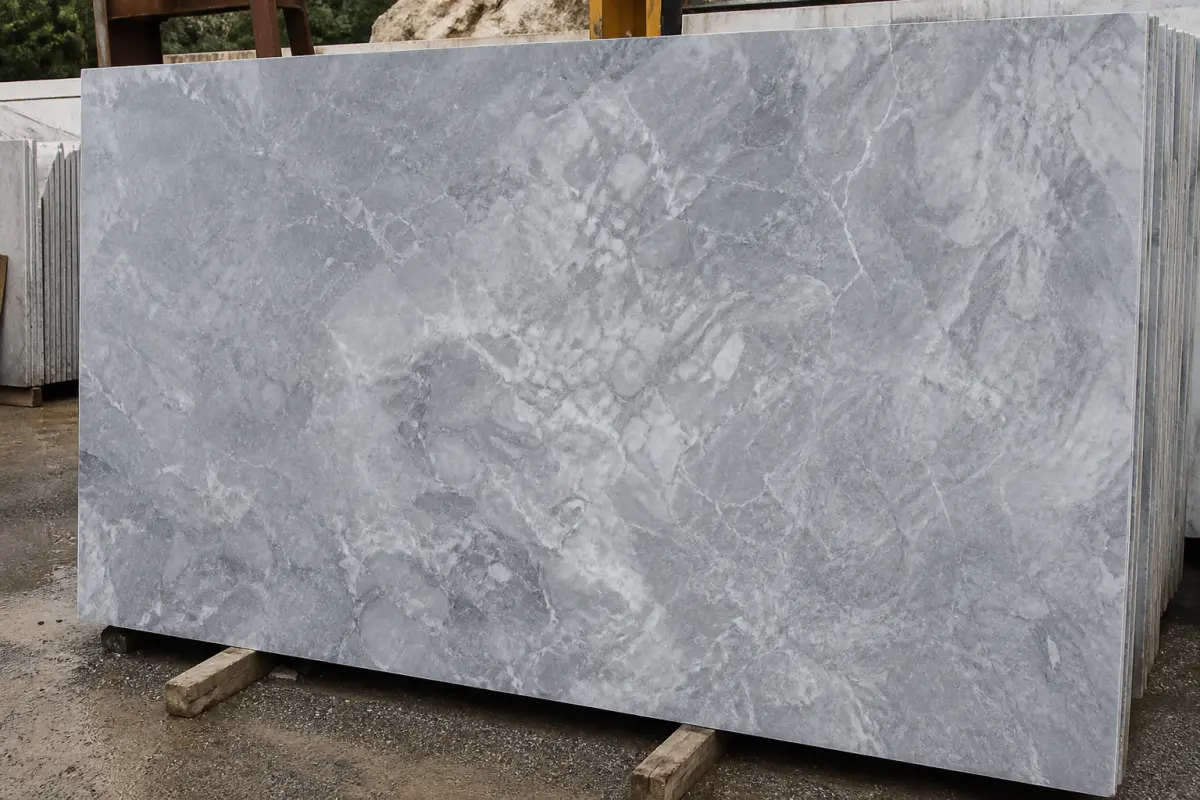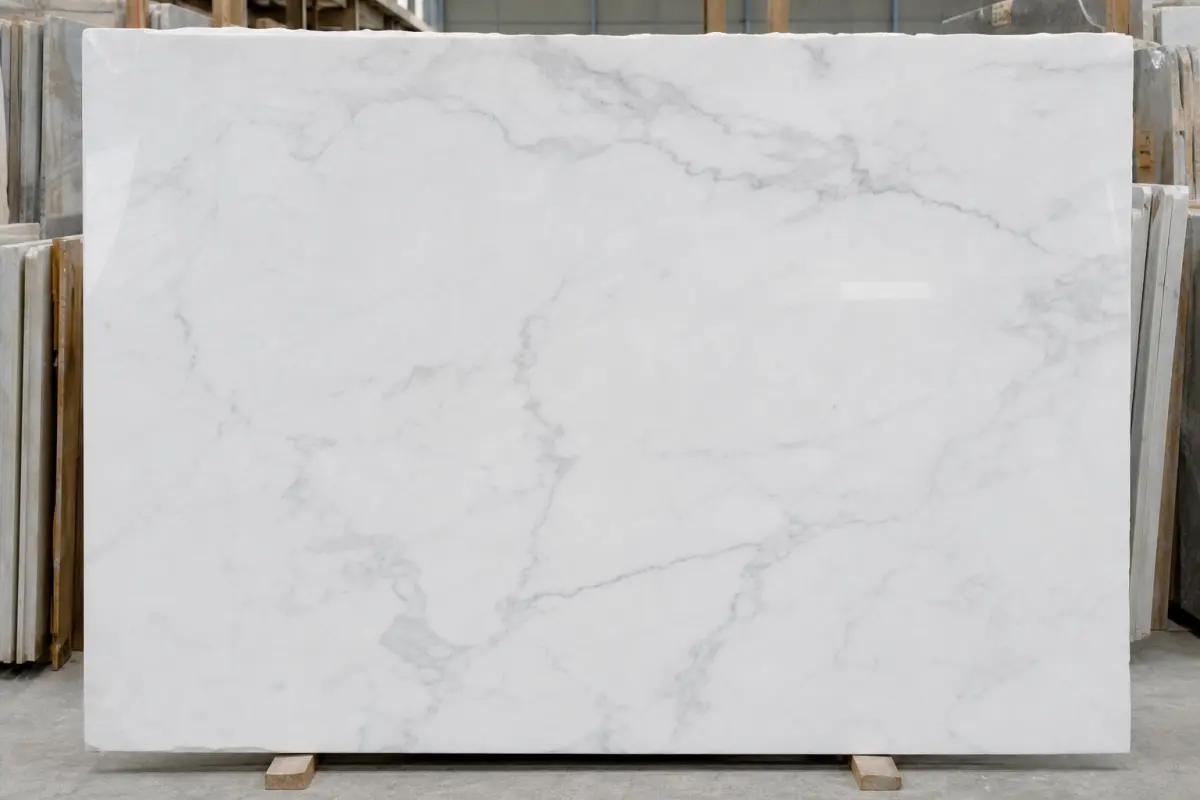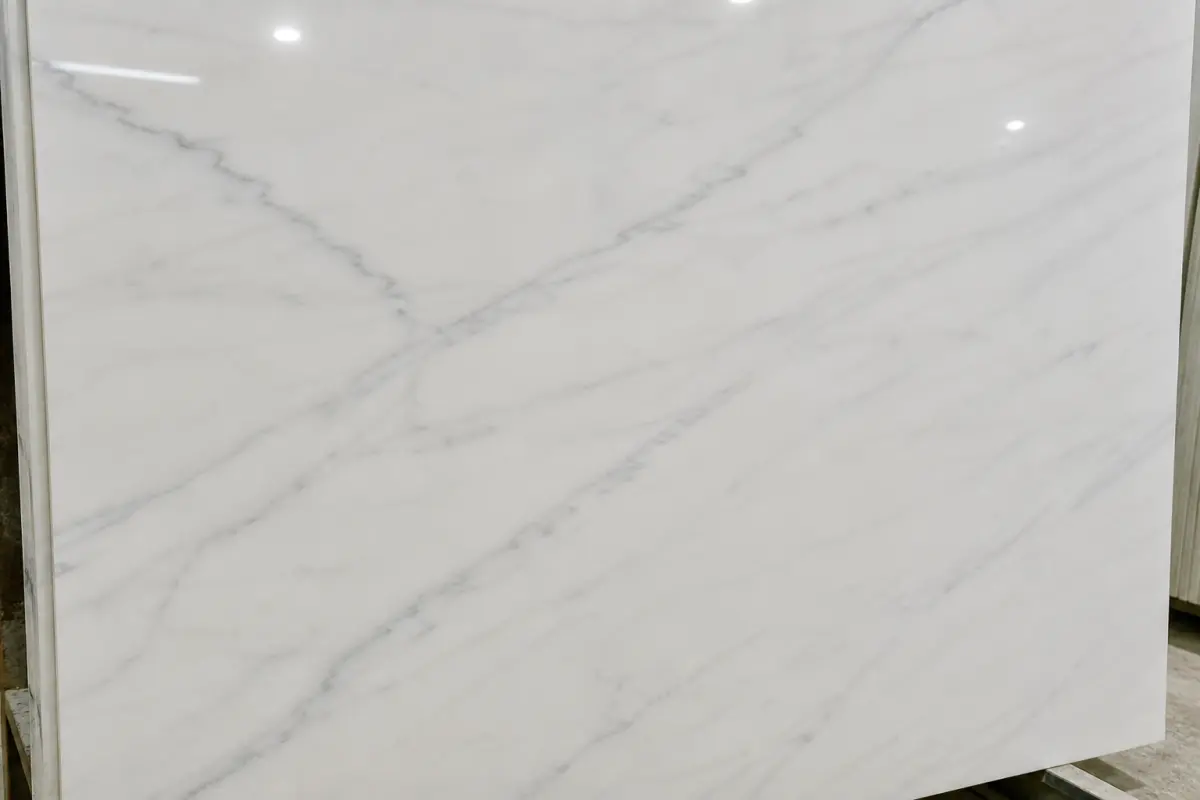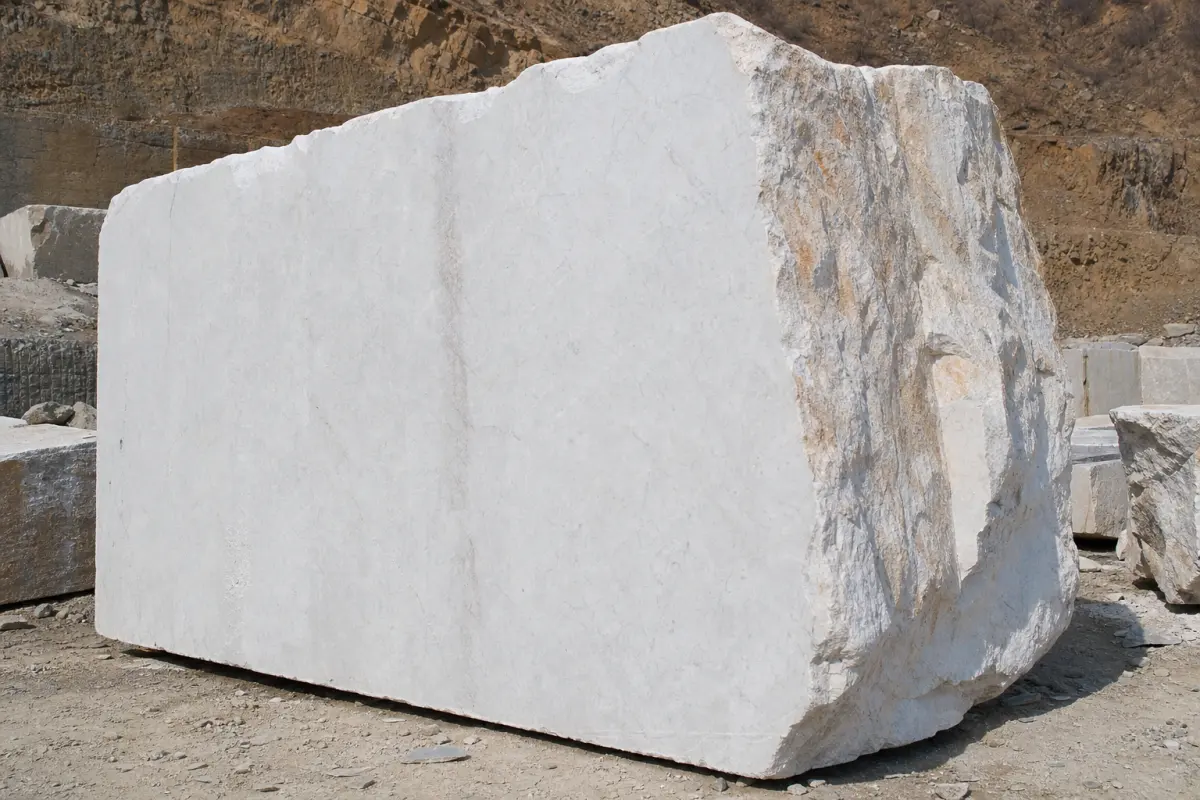
China remains a primary destination for Pakistani white marble blocks, not polished slabs. This trade-lane brief covers Bampokha block dimensions, grooved faces, wire-sawn versus blasted yield, HS 251512, and Qingdao or Shanghai discharge versus Karachi Port Qasim stuffing.
If you work in Yunfu, Nan’an, or a Shandong mill town, pakistan marble china does not mean a polished slab brochure. It means a 20-foot container of rectangular white blocks stuffed at Karachi Port Qasim, marked Bampokha or Pumpoo on the paint, and sold by the cubic metre or the ton. China has for years been the gravity well for Pakistani rough and sawn-to-rectangle marble. Gulf buyers take the polish. Chinese gangsaws take the mountain. This brief is the trade lane—how KPK quarries sell that stone, what a usable block looks like, and where the money leaks between a Buner face and a Qingdao discharge. It is not a repeat of our domestic raw-block sizes and packing guide. That article tells a cutter how to spec a block. This one tells an exporter and a Chinese buyer how the lane actually moves.
Bampokha sits in the hills above Buner’s factory belt. Local invoices still say Pumpoo or Pumpoo Khan. Blocks come off those benches, get squared (or not) at the quarry or in a Torwarsak yard, then ride south through Swari, past Daggar’s offices, onto the Peshawar corridor, and down to Karachi. Mingora traders in Swat often sit in the chat thread even when they never owned the lease. The Chinese principal may never see Buner. The stone still has to survive a Pakistani inland haul and a Chinese multi-wire bed that was designed for squares, not blast rubble.
Why China buys blocks and the Gulf buys slabs
Chinese processing cities run capacity that dwarfs Buner’s ~500 mills. Labour, resin lines, and tile calibration in Guangdong and Fujian turn a cheap white block into a finished SKU for domestic China and for re-export. Pakistani factories cannot compete with that finished-goods machine on price. They can compete on the block. HS heading 2515 is the customs language: 251511 for crude or roughly trimmed, 251512 for marble and travertine merely cut by sawing or otherwise into rectangular (including square) blocks or slabs. Chinese brokers who know the heading will reject a shapeless boulder invoiced as 251512 because the geometry is the classification. Get the heading and the physical form to agree, or the container sits.
Marble blocks pakistan export to China is therefore a geometry business dressed as a colour business. Colour gets you in the door—Bampokha white, super-white selections, commercial grey-white. Geometry decides yield on a Chinese multi-wire. A blasted, three-faced lump that a Swari mill would still clamp will waste the first and last cuts in Yunfu and arrive as an argument. That is why wire-sawn, grooved, six-face blocks from Bampokha command the premium in this lane even when the WhatsApp market still quotes “per ton white” as if all tons were equal.
Do not confuse this with the slab programmes we describe for Doha or Dubai. A hospitality buyer wants 2 cm polish and shade photos. A Chinese block buyer wants net cubic metres, face photos with a tape, and a stuffing plan that does not overweight a 20-foot. Mix the two conversations and you will send a mill a slab RFQ and a quarry a tile question. Keep block RFQs on raw block listings and slab RFQs on finished SKUs such as Bampokha No.1 slabs—those slabs are what a Chinese mill might produce after they own the block, not what you should ship as the China product unless that is a separate deal.
What a saleable Bampokha block looks like
Export-minded Buner yards aim at parallelepipeds a gangsaw can swallow: rough lengths often 240–320 cm, widths 120–180 cm, heights 100–160 cm, subject to the quarry road and the crane. Weight follows calcite density near 2.7 t/m³; a 2.8 × 1.5 × 1.3 m block is already a serious lift. Chinese buyers usually want a minimum of four reasonably square faces; six is the export grade. Grooved or wire-trimmed sides are not decoration. They are sling seats. A block with no groove and a blasted back will be rolled, chipped, and under-measured at stuffing.
Paint marks matter. Block number, quarry nickname, and a grade scribble (No.1, commercial, super white) should match the packing list row. Chinese customs and the receiving mill both photograph on arrival. A paint mark that says Bampokha on a Chamla contractor’s grey-white is a future claim. Our face-level map of Buner mines at Bampokha, Chamla, and Nanser is the right homework before you accept a mixed-colour container invoiced as one origin.
Trimming: some leases square at the face with a 37 kW class wire. Others dump irregular stone at Torwarsak and pay a mill to dress it. Dressing costs rupees and kerf. It also raises the chance the block actually classifies as 251512. Crude 251511 lots still move, at a discount, for buyers who will recut everything. Ask which heading the broker wants before you quote. Then show photos of the six faces, not a heroic quarry panorama.
Typical China lots are not one trophy block. They are 18–24 tons of mixed but related whites in a 20-foot, or a carefully planned 40-foot that still hits payload before it hits cube. Marble is heavy. Amateur stow is how you get an overweight hold at Port Qasim and a restuff bill that erases the quarry margin. Forwarders who regularly stuff stone should draw the stow. Quarry owners who “know trucks” still fail ocean payload math.
Wire-sawn versus blasted: the yield the Chinese mill actually gets
Buner still blasts. That is not a secret; it is the default on many leases, including commercial white and grey faces. A Chinese multi-wire does not forgive it. Internal fractures open as the blades descend. Resin consumption jumps. Tile calibre fails. The mill owner in Fujian does not care that explosives were cheaper on a Chagharzai bench. They care that a 15-ton block produced 8 tons of saleable slab. Read the extraction research in how Buner cuts marble from the mountain and then put the method on the purchase order: wire-sawn required, or blasted accepted at a named discount and a named expected waste band.
Khan’s 2019 Buner sustainability work already pointed Bampokha No.1 and Chagharzai white toward rope cutting, and left more room for semi-mechanised methods on Sunny Grey and Nanser black. Chinese white buyers are, in practice, shopping the first group even when they do not know the paper. If your lease is still a blast face, price it as blast. Do not send it as Bampokha No.1 export block and argue later.
Grooving after the primary cut is a second wire or a chainsaw pass. It takes an afternoon. It saves a broken corner in Karachi. Chinese inspectors look for parallel saw marks. Scalloped blast cups on the back face are a negotiation, not a surprise, if you photographed them. Hide them under mud and you will eat a claim in Qingdao.
Karachi stuffing versus Qingdao and Shanghai discharge
The Pakistani end of the lane is almost always Karachi Port or Port Qasim after the long inland haul. Gwadar is a speech, not a marble habit. Stuffing may happen at a Karachi stone yard, a dry-port buffer, or rarely at a northern depot if a forwarder is willing to run a bonded movement. Factory-gate stuffing in Torwarsak sounds efficient and is uncommon for China blocks: the crane, the container, and the customs exam all sit more naturally in Karachi. Budget the inland leg explicitly. Our quarry-to-Karachi logistics guide covers breakage, tarps, and who photographs at which gate. Block chains and chocks are not slab A-frames; do not reuse a slab forwarder who has never lashed 20-ton cubes.
On the Chinese side, discharge port follows the mill cluster. Qingdao serves Shandong and much of the north. Shanghai and Ningbo serve East China mills and traders. Huangpu, Shekou, or nearby South China ports feed Yunfu. The same Bampokha block is a different inland trucking bill after each of those berths. A Karachi seller who marks “CIF China” without a port is not quoting. A buyer who says “CIF Shanghai” when the mill is in Yunfu is buying an extra week and a second truck. Name the port. Name whether the rate is CIF, CFR, or FOB Karachi with the buyer’s own freight contract—see FOB Karachi from KPK factories for the handoff language mills actually understand.
Transit time Karachi to East or North China is typically in the three-to-five-week band depending on service and transshipment in Colombo, Singapore, or Port Klang. Direct services exist in some seasons and vanish in others. Block buyers should not plan a gangsaw shift on a promised 22-day sailing. Plan on the photo of the loaded vessel and a buffer. Demurrage in China on a stone container that nobody declared correctly is how a cheap block becomes an expensive block.
Who is actually selling: lease, contractor, Torwarsak yard, Karachi desk
Four parties can appear on a China PI. The lease holder in Bampokha may never speak English. The contractor who pays per-ton or a monthly take-off runs the face and the first trucks. A Torwarsak or Swari yard owner squares, stocks, and sells mixed benches. A Karachi or Peshawar exporter issues the invoice, books the vessel, and may never have stood on the bench. All four can be legitimate. Only one of them controls the next month’s colour. Ask who that is. Our cluster note on Bampokha marble suppliers is the local map; this lane adds the Karachi and China nodes.
Chinese purchasing offices historically sent agents to Karachi Saddar and to Peshawar. Some still do. Others buy on WeChat from a Pakistani trader who restacks photos. The second path is faster and is how mixed Chamla/Bampokha lots get described as one grade. If you are the Chinese mill, require face photos with a date, a tape, and the block ID painted before the truck leaves the quarry—not after a yard wash in Karachi. If you are the quarry, do not let a trader re-mark your commercial white as super white on the container; provincial royalty already prices those tiers differently, and a mismatch is both a tax problem and a buyer problem.
Payment in this lane is usually T/T: deposit to start loading, balance against bill of lading. Letters of credit appear on larger programmes and with state-linked Chinese buyers. Many Buner contractors cannot work an LC without the Karachi exporter in the middle. That middle is a cost. It is also how the document set (invoice, packing list, origin, weight list) gets done. Do not pretend a hill contractor will issue an FBR-clean 251512 invoice unless they already do. Our export documents brief is the checklist; China-bound blocks add weight certificates and a description that must not say “slabs” if the box holds cubes.
Pricing signals that are not WhatsApp folklore
Ex-quarry rupee-per-ton is not FOB Karachi and is not CIF Qingdao. Diesel, royalty (super white versus ordinary marble versus kanda), squaring loss, trucking, stuffing, and terminal handling each take a slice. Blasted lots look cheap at the face and expensive at the Chinese saw. Wire-sawn Bampokha whites look expensive at the face and predictable in Fujian. Quote both, with method named, or you are not in the same market.
Seasonality: monsoon cuts quarry roads above Swari and Chamla. Chinese New Year empties mill demand and clogs berths on the way back. A December stuffing for a buyer who is about to shut the factory for two weeks is how you pay storage in China. Align quarry production with the mill calendar, not with the contractor’s need to make payroll this Friday.
Black and decorative blocks from Nanser are a different Chinese conversation—smaller lots, different mills, sometimes ornamental rather than tile. Do not mix a jet-black cube into a white Bampokha container to “fill weight.” You will scratch the whites and confuse the heading. Sell Nanser on its own packing list, or keep it in the domestic black-slab channel.
How to RFQ Bampokha blocks for China on StoneVaults
State destination mill city or at least discharge port. State HS intent (251512 rectangular versus crude). State minimum dimensions, maximum weight per piece, groove required or not, wire-sawn required or discounted blast. State whether mixed commercial/No.1 is acceptable. Attach a photo of the last accepted block if this is a repeat. Put quantity in cubic metres and in estimated tons so the mill and the forwarder are not converting in their heads.
Use the Bampokha raw marble block listing as the SKU template and the Pakistan marketplace to let verified exporters bid. Factory-direct KPK names such as Zeex Naturals and Ayaz Marble may sell blocks, slabs, or both—read the listing form. A slab mill answering a China block RFQ is only useful if they control quarry intake. A quarry contractor answering a slab RFQ is the reverse error.
- Photograph six faces and the groove before the truck leaves Buner.
- Paint block IDs that match the packing list and the PI.
- Name Karachi stuffing point and China discharge port on the same page.
- Separate Bampokha from Chamla and Nanser on invoices even if they share a truck to Qasim.
- Tie payment to loading photos and B/L, not to a voice note from Mingora.
China will keep buying Pakistani white blocks as long as Yunfu and Fujian can turn them into cheaper finished goods than Buner can. That is the lane. Treat bampokha blocks china as a geometry-and-documents product with a long inland leg, not as a colour slogan. Square the stone, name the heading, stuff within payload, and keep the face honest. The Chinese gangsaw will do the rest—or it will send you a claim that started on a blasted bench above Torwarsak.