Bampokha—also spelled Bampkha, Bumpukha, Pumpoo Khan, or Pampu—is the quarry village behind Pakistan’s export white. This cluster guide shows how to find Bampokha marble suppliers, who holds blocks versus who saws in Torwarsak, and how to RFQ without mixing mill and mine.
Importers type five different English spellings and think they have found five mountains. They have usually found one village. Bampokha, Bampkha, Bumpukha, Pumpoo Khan, Pampu—local speech and old papers scatter the Latin letters, while the trucks still climb the same hill above the Daggar side of Buner. Bampokha marble suppliers are the people who control those blocks, saw them in the Torwarsak–Swari belt, or both. This page is a supplier-finding guide for that cluster. It is not a colour-grading essay; for origin and commercial grades, use Bampokha / Pumpoo white marble origin and grades. Here the question is who you actually RFQ.
The village sits inside Buner District, Malakand Division, Khyber Pakhtunkhwa, in the same industrial story as Nanser, Chamla, and Chagharzai. Processing, not the face, is what most overseas buyers will visit: gangsaws, gantries, slurry, PESCO cuts in the afternoon. Association planning figures still talk about hundreds of mills in Buner. Only a slice of them regularly handle Bampokha white as a named SKU rather than as “whatever white came on the trailer.” Your job is to find that slice, separate lease-side block control from mill-side sawing, and write an RFQ that cannot be answered with a Karachi stock photo.
Finding Bampokha marble suppliers when the village has five English spellings
Search like a clerk, not like a poet. Keep a note of every spelling you see on invoices, lease papers, and WhatsApp display names. A mill that writes “Bumpukha No.1” on a bundle and “Bampokha Super White” on an Alibaba page is often the same stone with two marketing moods. Ask them to pick one commercial name for your PO and to put the village name in parentheses. Bampokha marble suppliers who refuse to stabilize spelling will also refuse to stabilize shade lots. That is a character tell.
Directories will list traders in Karachi as “Bampokha factory.” Sometimes they have a real offtake. Sometimes they bought a bundle. Ask where the stone sits today. If the honest answer is a packing shed near Port Qasim, you are talking to a packer or a trader. That can still be the right call for FOB. It is the wrong call if you think you have booked blade time in Torwarsak. StoneVaults listings should carry origin and form separately so a Bampokha No.1 slab and a raw block do not hide under one “white marble” card.
Where Bampokha sits: Daggar, the hills, and the road to Torwarsak
Daggar is the town buyers use as a meeting point and as a mental pin for the district. The quarry cluster is not a showroom on the main bazaar. Faces sit in the hills; trucks come down toward the processing belt. Torwarsak and Swari are where you will spend inspection time because that is where three-phase power, water, and crane density exist. Elai appears in the same white conversation. If a supplier cannot place Bampokha relative to Daggar and cannot say which road the blocks use to reach the mill, they are repeating a brand, not a logistics chain.
Road time matters for quotes. A block sitting at the face and a block already in a Torwarsak yard are not the same SKU. The yard block can be sawn this week if the feeder holds. The face block still needs blasting or wire time, a trailer, and a day that is not a strike or a washout. When you RFQ Bampokha marble suppliers, ask “in yard or at face?” the way you would ask thickness. Buyers who skip that question buy a calendar they did not price.
Spelling variants you should treat as one cluster
Keep a single internal code in your procurement sheet—Bampokha—and map every incoming spelling to it. Pumpoo Khan and Pampu show up in older English and in some Chinese buyer chats. Bumpukha and Bampkha show up on mill boards. Do not let accounts payable treat them as four vendors. Do let quality control treat them as one origin family that still needs lot photos, because one village is not one face.
Who controls the block versus who saws it
This is the split that saves money. Lease holders and their offtake partners decide which 12–22 ton blocks leave the hill and at what asking price. Gangsaw owners in Torwarsak decide blade time, yield, resin, and polish. Some families do both. Many do one. A WhatsApp number that says “we are the quarry” may be selling mill hours on someone else’s block, or selling blocks to be sawn at a mill they do not own. Neither is a crime. Mixing the roles on your PO is how double margin appears without a line item.
Ask two names: block principal and saw principal. If they are the same NTN, you have a tighter factory-direct story. If they differ, price the offtake and the sawing so you can see the spread. For how that hire feels in practice, the factory-direct playbook at Buner marble supplier, factory-direct is the method; this page is the cluster directory logic behind the names. Also ask extraction method. Blasting is still common on these faces; wire-sawn blocks usually yield cleaner slabs. Pay for the method you want, or accept the resin bill later.
- Block principal: lease or offtake, painted marks, dimension list, blasting vs wire.
- Saw principal: mill town, thickness, mesh/resin, shade-lot letters, polish line.
- Packer: A-frames, fumigation, Port Qasim or Karachi Port stuffing—often a third name.
- Never let one chat identity silently switch among those three mid-order.
Commercial names that leave the same hill
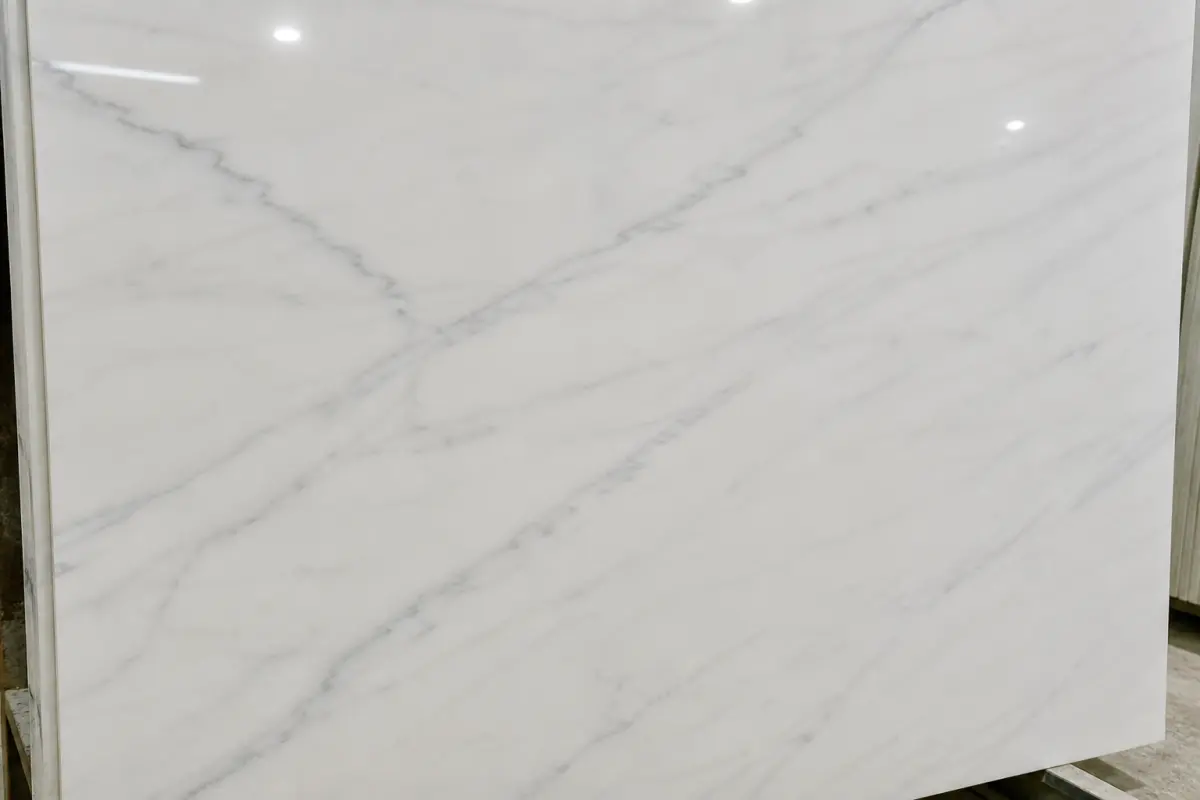
Bampokha No.1 white, Super White, Sunny White, Sunny Grey—these labels leave the same cluster with different sorting. No.1 is the reference export white many Gulf buyers mean even when they say Carrara in a meeting. Super White is a brightness sort, not a different planet. Sunny White and grey sit on the same family with more movement. Traders will upgrade the name to match your mood board. Mills that want repeat business will downgrade the name until you accept the photo. Prefer the mill habit.
Do not treat Badal grey, Nanser black, or honey onyx as Bampokha just because the mill is in Buner. Those are other conversations that often share a packing lane. If a supplier’s catalogue is a rainbow, ask which SKUs are actually in the yard this month. Feature stone is fine. Feature stone pretending to be homogeneous Bampokha white is how hotel floors get a surprise vein through the reception desk. For grade-by-use, wait for the white export article; for mines as geography, see Bampokha, Chamla, and Nanser mines.
How a cluster RFQ should be written
Address the cluster, not “Pakistan white.” Write: origin Bampokha (Buner), form slab or block, commercial grade (No.1 / Super White / Sunny), thickness, finish, mesh, quantity, in-yard versus at-face, Incoterm (ex-factory Torwarsak or FOB Karachi), inspection in mill town, payment milestones. Attach a like photo and a reject photo. Ask for painted block numbers in the reply. Bampokha marble suppliers who answer with a generic Carrara JPEG have told you they are not the cluster. Move on.
File that RFQ on StoneVaults so two mills can bid on the same document. WhatsApp can carry the yard video. The RFQ should carry the spec. If you are buying blocks for a Chinese sawing programme, say so; dimension regularity and fracture matter more than polish photos. If you are buying slabs for a UAE villa, polish and shade-lot letters matter more than raw-face drama. The cluster can serve both. It cannot serve both on one vague “best quality” line.
MOQ and mixed lots inside the village brand
Small villa programmes sometimes need 200–400 m². Mills prefer container-shaped orders because blade time is the scarce asset. Be honest about MOQ. A mixed lot (some No.1, some Sunny Grey fillers) can make a container work if you design for it. A mixed lot that you hoped would all look like the hero slab will fail inspection. State whether mixing is allowed. Cluster suppliers respect a clear mix. They resent a silent one that becomes a claim in Jebel Ali.
Blocks for China, slabs for the Gulf, tiles for domestic yards
China-facing block trade wants 12–22 ton pieces, fewer surprises in the heart of the block, and loading that a trailer can actually carry down from the hill. Gulf slab trade wants sorted whites, 2 cm or 3 cm, mesh, and crates that survive Karachi humidity. Domestic Pakistan yards want 60×60 and random slabs for Peshawar and Mardan projects, often ex-factory, often with less crate theatre. Same village, three products. Ask the supplier which of those three they ran last month. Capacity is habit, not a PDF.
If your programme is blocks, stay close to the principal who marks faces and keep raw block listings open so you can compare dimensions. If your programme is slabs, stay close to the mill that will still be answering the phone when the second container needs a match. If your programme is tiles, confirm calibre on the line that will cut them, not on a slab photo. Bampokha marble suppliers who claim all three at once may be brokering two of them. That is allowed. It should be visible.
Visiting the village versus visiting the mill
Visit the mill first. You will see the stone you might buy, the power reality, and the people who will pack your lot. Visit the village if the order is large, if you are buying blocks at face, or if you have a reason not to trust the offtake story. Quarry visits need a local companion, time, and a respect for working faces. They are not a picnic content shoot. Blasting schedules are not arranged around your drone. Go to confirm marks and access, not to collect inspirational video.
If you cannot visit, require a mill video this week and a face video if the blocks are not yet in the yard. Date stamps, a newspaper, a phone clock—whatever you and the mill agree. Upload to the RFQ. Third-party inspectors who already work Torwarsak can add a walk-through without you flying to Peshawar. Budget them. The cost is smaller than one mis-sorted container of “Bampokha” that is actually mixed Chamla.
The track off the face is not a highway. Trailers that look fine on the Swari road can be wrong for a 20-ton block on a steep access in wet weather. Ask the block principal what actually came down last week: tractor-trailer, smaller rig, or a wait for the track to dry. That answer belongs in the lead time. Buyers who price “Buner to Karachi, four days” as if every block is already sitting under a gantry in Torwarsak are pricing a yard SKU while paying for a face SKU. Split the calendar: days to yard, days on the gangsaw, days on the southbound haul, days in the Karachi shed. Four numbers prevent one lie.
Payment should follow those four numbers. A deposit to the block principal is not a deposit to the mill. If you are buying offtake and sawing from two NTNs, write two schedules: one against marked blocks in the yard, one against bundle photos after polish. 30 / 40 / 30 still works, but the 30% should not vanish into a cousin’s personal account because “we are one family.” Shade-lot letters should appear before the second tranche on slabs. For blocks, dimension lists and face photos with the painted mark should appear before the second tranche. Cluster suppliers who already sell to China on blocks are used to this. New WhatsApp sellers are not. Choose accordingly.
- Ask in-yard versus at-face on every Bampokha quote, then price the truck off the hill separately if needed.
- Do not send one deposit that is supposed to cover quarry offtake, sawing, and Karachi packing.
- Photograph painted marks at face or yard intake, at mill, and on the crate—three photos, one number.
- Hold final payment against packing list lines that still carry those numbers.
Documents: lease marks, block numbers, and FBR invoices
Painted marks on the block are the cluster’s serial numbers. Photograph them at purchase, at mill intake, and on the bundle. Lease or offtake paper explains who had the right to move the stone. FBR invoices explain who you paid. After the old PATA tax holiday, expect sales tax language on compliant mills. A cluster seller who can only do cash and a handwritten chit is a domestic convenience, not an export counterparty. Your bank will agree, loudly, at the worst moment.
Packing lists should carry the same block numbers through to crate marks. When they do not, shade claims become theology. Bampokha marble suppliers who already export to the Gulf or to China have this habit. New sellers may not. Teach it on the first order or pick someone who already has the habit. For international project language on the same stone, continue to Bampokha white marble for international projects once you have a supplier name.
Nanser, Chamla, Chagharzai—when not to substitute
Neighbouring clusters are not insults. They are different stone. Nanser is the black story. Chamla and Chagharzai feed whites and greys that can look close to Bampokha in a phone photo and drift on a 2,000 m² floor. Substitution is a written change order, not a mill manager’s late-night decision when a trailer is empty. If the mill is short of Bampokha this month, you want to know before polish, not at the port. Put “no silent substitution of origin cluster” in the RFQ. It sounds legalistic. It is how you keep the village name honest.
Grey Badal-style material is often the right cheaper field stone beside a Bampokha dado. That is design, not substitution. Design it. Do not discover it. Chamla suppliers deserve their own shortlist; they are not a backup drawer labelled Bampokha. Keep the names separate on StoneVaults so your second project does not inherit a muddle.
Comparing Bampokha marble suppliers on StoneVaults
Filter the marketplace for Pakistan, white marble, and Buner origin. Open slab and block SKUs that say Bampokha, not only “KPK white.” Read Zeex Naturals and AYAZ MARBLE as named, visitable starting points, then add a second mill so you are not hostage to one feeder. File one RFQ from contact or the listing with spelling locked, roles split (block / saw / pack), and in-yard versus at-face. Compare replies on marks and calendar. That is supplier-finding for this village.
The cluster behind Pakistan’s export white is small enough to learn and large enough to fake. Learn the spellings, split the roles, freeze the lot, and keep the painted number from the hill to the crate. A Bampokha marble supplier is not a hashtag. It is a person who can show you the mark. Use the grades article for colour. Use this page to find the people. Then stay with the ones who still answer when the second container needs to match the first.