Chamla and Chagharzai feed the same Torwarsak and Swari mills as Bampokha, but they sell a different mix of greys and whites. This guide covers overlooked Buner suppliers, logistics off the famous white brand, and when to specify those valleys on purpose.
Most export conversations about Buner stop at Bampokha. That is understandable: No.1 white and Super White pay the invoices that reach Doha and Qingdao. It is also lazy. Chamla marble and chagharzai marble come off other valleys in the same district, ride the same roads into Torwarsak and Swari, and occupy the same gangsaw beds. They are not leftovers. They are the greys and commercial whites that should have been specified on half the BOQs that were written as “Buner white” because someone liked a Bampokha sample in a Daggar office. This guide is for buyers who want the belt beyond the famous hill: who sells, how the stone moves, and when to write Chamla or Chagharzai on the RFQ instead of forcing every square metre through a No.1 sort.
Chamla sits in Buner’s valley geography as a named source that mills already know and overseas buyers often do not. Chagharzai is a tehsil and a set of higher, slower faces. Both are easy to confuse with “somewhere near Bampokha” on a packing list. Both feed Elai job shops and Swari yards. Mingora traders will still take the meeting. Peshawar will still do the banking. Karachi Port Qasim will still stuff the crate. The difference is the rock and the road, not the downstream map. Pair this supplier note with the mine tour of Bampokha, Chamla, and Nanser faces and with the wider KPK buyer map so you are not using three articles to learn the same highway.
Why these valleys are overlooked—and why mills are not
Bampokha has a brand. Chamla has trucks. Overseas architects search the brand. Local mill owners buy the trucks. When a Torwarsak gangsaw is hungry and Bampokha No.1 is allocated to an export hold, the next blocks in the yard are often Chamla commercial white or a grey that will polish into something a Pakistani contractor will call Badal-adjacent. That mill-level reality never reaches a Gulf PI that only says Sunny White. You then get either a wait or a quiet substitution. Specifying Chamla on purpose ends the substitution game.
Chagharzai is overlooked for a ruder reason: it is farther, the road is worse, and the contractor pool is thinner. Research that ranked Buner deposits for mechanisation treated Chagharzai white as worth a wire, in the same breath as Bampokha No.1. That is a quality signal. It is also a capital signal: if the wire is not there, you are buying blast geometry from a remote tehsil. Do not romanticise remoteness as purity. Remote often means more powder, more irregular cubes, and a loader that is rented by the day.
Suppliers who only market Bampokha are not lying about what pays. They are omitting what they will ship when Bampokha is tight. Buner marble suppliers Chamla are often the same families, or the same yards, with a second paint mark. Your job is to make the paint mark match the PO.
What Chamla suppliers actually sell
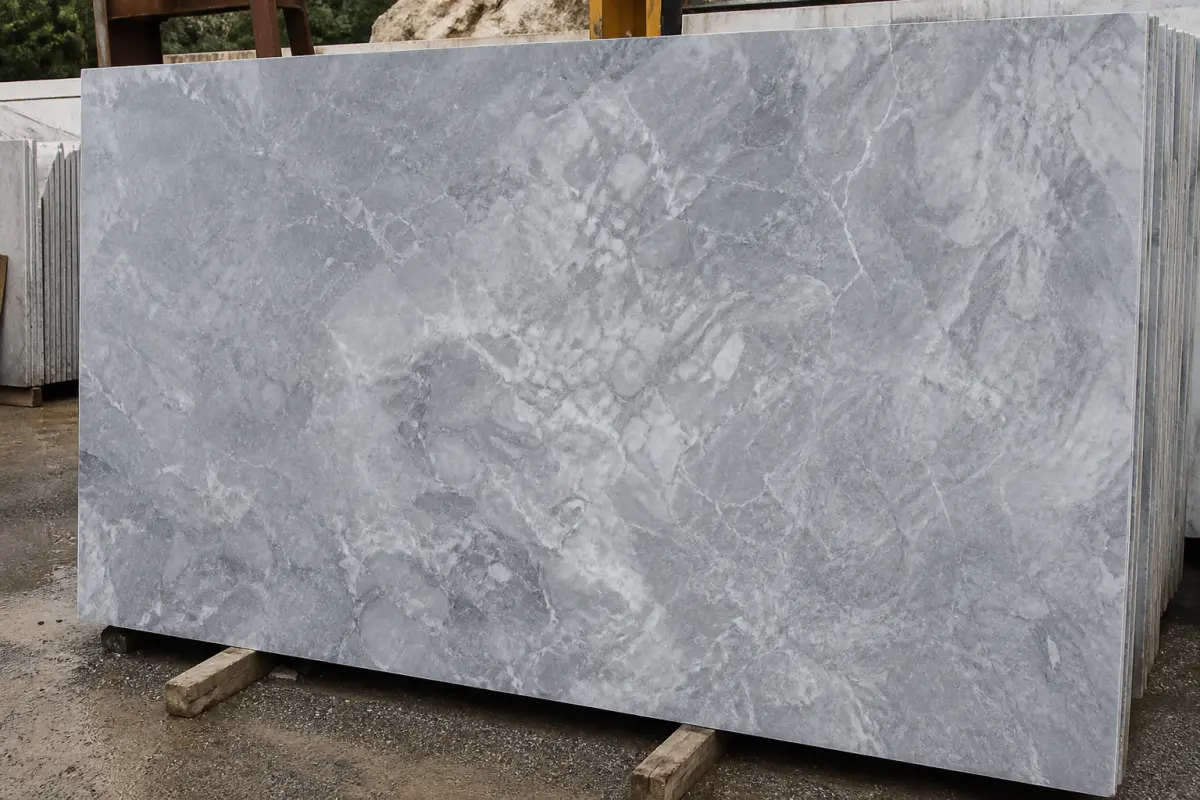
Expect a mix of white and grey, with more colour movement than a first-selection Bampokha bundle. Some faces are clean enough for export commercial flooring. Some are domestic. Grey programmes are the natural fit: large fields where a bright white would show every mop scratch and every shade step. Badal grey slabs in mill catalogues often draw on this kind of ground even when the sales card still says a more famous name. Ask. If the mill can show a Chamla face photo that matches the grey sample, write Chamla. You will pay less than No.1 and you will have an origin you can audit.
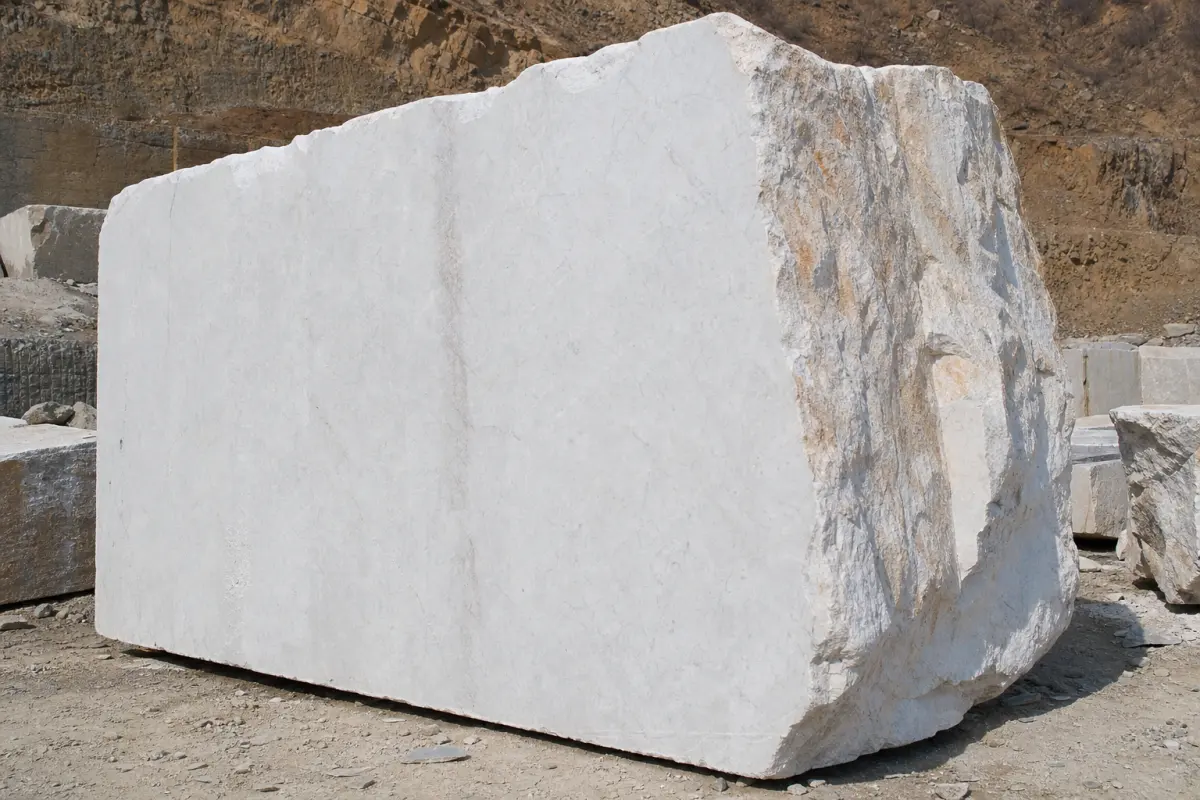
White from Chamla can fill 60×60 tile lines and commercial 2 cm floors. It is a poor silent substitute for a Super White lobby. Compare against Super White and Bampokha No.1 under the same lamp. If the architect prefers the Chamla tile for a back-of-house or a budget wing, that is a win. If they preferred Bampokha and you shipped Chamla, that is a snagging list. Tile calibre still matters; a Chamla-fed bridge saw in Swari is not automatically worse than a Bampokha-fed one. The saw is the saw. The block is the variable.
Blocks: China-bound programmes sometimes take Chamla commercial whites when Bampokha squares are priced out. That only works if the geometry is honest—see the Bampokha-to-China block lane for heading and groove discipline, then apply it here. Do not dump Chamla rubble into a 251512 container because the white is “almost the same.”
What Chagharzai suppliers actually sell
Chagharzai whites, when the face is good and the cut is a wire, compete with better Buner whites. When the face is blasted, they compete with ordinary commercial. Greys appear. Volume is smaller and less regular than Bampokha. A supplier who promises a monthly 20-foot of identical Chagharzai Super White is selling a forecast, not a stockpile. Ask for the last three loading weeks of photos. If they only have one heroic bench shot, you do not have a supplier. You have a brochure.
Because the tehsil is more remote, many “Chagharzai suppliers” are Torwarsak mills or Swari yards with a contractor on the hill, not a showroom in Chagharzai. That is fine if disclosed. It is the normal Buner pattern: extraction up, processing down. What you want on the RFQ is the face name plus the mill GPS. A Daggar trader who has never sent a truck to the tehsil this quarter is not a Chagharzai supplier.
Black is not this belt’s headline. If you need black, you are usually in Nanser talk. If a Chagharzai contractor offers dark stone, sample it as its own SKU, not as a Nanser replacement. Keep packing lists clean.
Logistics: same mills, longer hill, same port
Chamla and Chagharzai stone still wants Torwarsak and Swari blade time, Elai finishing for smaller jobs, then the Peshawar corridor and Karachi for export. The extra kilometres are on the quarry road, not on the motorway. That extra is where monsoon and contractor reliability live. A Bampokha lease that has run export for a decade has a known truck habit. A Chagharzai contractor who loads when the family needs cash does not. Build time into anything that is not yard stock in Swari.
Power at the mill is the same PESCO story as any Buner white. Load shedding does not care which valley the block came from. See the electricity note. Tax on the mill invoice is the same post-PATA sales-tax world as the rest of the cluster—factory tax research. Do not expect a Chamla origin to mean a cheaper tax line. It might mean a cheaper block. The mill still invoices as a mill.
Mixing faces on one truck from the hills is normal. Mixing faces in one export bundle without saying so is not. Instruct the mill: Chamla commercial in crates A–D, Bampokha No.1 in crates E–H, no “almost.” Photograph the yard sort. If they cannot sort, they cannot do hospitality and they cannot do a US distributor trial. They can still do a Pakistani commercial floor.
When to specify Chamla or Chagharzai instead of Bampokha
Specify Chamla when the job is volume grey or commercial white, when you want a named origin for an audit, when Bampokha No.1 is on allocation, or when the sample you actually liked was Chamla and you have been calling it Buner out of habit. Specify Chagharzai when a mill can prove a current white or grey face that matches the mock-up and when you have accepted the logistics. Specify Bampokha when the approved board is No.1 or Super White and the operator will walk the floor with that board in hand.
Do not specify these valleys as a bargain Bampokha. That framing invites the mill to under-sort. Frame them as the correct stone for the zone, the way you would put Badal in a corridor and Super White in a lobby. Our hotel-zone logic in the commercial marble supply note applies inside one district, not only across countries.
Factory-direct still beats a nameless WhatsApp. The Buner factory-direct guide is the process. This article is the origin filter. Visit Swari or Torwarsak and ask the owner to point at which stack is Chamla this week. If he waves at the whole yard, you are in a mixed-grade shop. That can work for a domestic contractor. It does not work for a repeat export SKU.
How to vet a Chamla or Chagharzai supplier
Ask for the face video, the contractor name, and the mill address as three different facts. Ask whether they own blade time or rent it. Ask whether they will issue an FBR-compliant invoice with the origin spelled the way your packing list will spell it. Ask extraction method. A Chagharzai white that was wire-cut is a different RFQ from a Chamla blast commercial, even if both polish grey-white.
Compare at least one Bampokha sample and one Chamla sample in the same crate to Doha, Dubai, Karachi, or your own office. Committees decide with their eyes. If they pick Chamla, stop paying No.1 prices. If they pick Bampokha, stop letting Chamla into that bundle. This is the whole game.
Verified listings help because they force a product photo and a form (slab, tile, block). Use the Pakistan marketplace, factory profiles such as Zeex Naturals and Ayaz Marble, and a structured RFQ that names Chamla or Chagharzai in the origin field. If you need 60×60, say so with the Buner 60×60 tile as a format reference, not as an origin claim. If you need black, you are probably not in this article—go back to Nanser. If you need onyx, you are in a feature shop, not a Chamla grey programme.
A practical visit: Daggar, Swari, then the hill
Fly or drive to Peshawar, overnight if you must, then into Buner via the Malakand road. Daggar is where you confirm who you are meeting; it is not where the stone sits. Swari is the first useful yard day: walk block stacks, read paint marks, and ask the mill owner to separate “Bampokha this week” from “Chamla this week” with his finger, not with a speech. Torwarsak is the second yard day—gangsaws, slurry, the polish line you will actually fund. Elai is worth an hour if your package includes cut-to-size vanities or mosque panels that a primary mill will job out.
The Chamla face, if they will take you, is a morning, not a postcard stop. Wear boots. The road is a working track. Take a 30 × 30 cm approved tile in your bag and hold it against freshly cut faces, not against a polished remnant in the mill office. For Chagharzai, decide in Swari whether the extra hours are worth it for this PO. A video from the contractor plus three weeks of loading photos is often the adult substitute for a first trip into the tehsil. A second trip, after a trial bundle, is how serious volume buyers lock a face. Cold tourism into Chagharzai without a mill introduction wastes everyone’s diesel.
Mingora still appears on itineraries because hotels, interpreters, and traders concentrate there. Use it as a bed, not as a quarry. A Swat meeting about Chamla stone is only useful if the trader discloses the Buner mill and the face. Otherwise you have added a margin and lost a name. The Torwarsak–Swari map is the walking document; this article is the origin filter you carry in the same pocket.
Pricing, mill politics, and what “cheaper” means
Chamla commercial white is cheaper than Bampokha No.1 at the bench because royalty, demand, and sorting labour are different. It is not automatically cheaper FOB Karachi Port Qasim if the mill still has to square blasted cubes, resin a broken field, and wait on the same PESCO night shift. Price the finished SKU, not the valley myth. A wire-sawn Chagharzai white can land above a blasted Bampokha commercial. That is not a contradiction. Geometry and waste dominate.
Mill politics: owners keep a Bampokha story on the website and a Chamla stack in the yard. They are not two companies. They are one gangsaw with two intake contractors. If you are a repeat Gulf buyer, you want both stacks visible on the RFQ so you can assign zones. If you are a one-container hunter chasing the lowest WhatsApp number, you will be sold whichever stack needs to move. Factory-direct still requires you to name the face. Direct to a mill that mixes silently is not a win.
Domestic Pakistani contractors already know this. They buy Chamla grey for floors in Mardan and Peshawar and keep Bampokha for the prayer hall. Overseas buyers who copy only the prayer-hall spec onto a 6,000 m² commercial plate overpay and then complain the mill is slow. Give the mill the Chamla work. Keep Bampokha for the board that was approved as Bampokha. Everyone’s calendar improves.
- Write the valley name on the PO and the packing list, not only in a chat.
- Use Chamla/Chagharzai on purpose for greys and commercial whites.
- Do not substitute them for approved Bampokha No.1 without a new mock-up.
- Budget extra hill time in monsoon, especially for Chagharzai.
- Sort faces in the Torwarsak yard before crating, with photos.
- Keep mill GPS and face name as separate fields on StoneVaults RFQs.
- Hold a Chamla sample next to Bampokha under the same lamp before you assign zones.
Where this sits on the KPK map
Buner remains the processing capital of Malakand Division. Chamla and Chagharzai are why that capital has enough mixed colour to keep hundreds of gangsaws busy when the famous white is allocated. They are not Swat mines, though Mingora will still broker them. They are not Dir granite. They are not a Karachi invention. The district map in KP marble districts is the wide lens; this is the local lens. Factory rows stay in Torwarsak, Swari, and Elai. The overlooked belt is the hill behind the signboard.
Buyers who learn these names stop overpaying for No.1 on corridors and stop being surprised when a “Buner white” container looks grey in Hamad light. Suppliers who list Chamla and Chagharzai as themselves, rather than as backup Bampokha, will get the RFQs that match their trucks. That is the point of a B2B marketplace. Put the valley on the listing. Put the mill on the map. Let the architect choose with both eyes open. The belt beyond Bampokha is not a secret inside Buner. It is only a secret on the internet, and that is a fixable problem.