Overseas architects specifying Bampokha (Pumpoo Khan) white marble need more than a WhatsApp photo. This spec sheet covers brightness, vein, thickness, bookmatch, wet-area resin, and crate evidence that GCC and Asian project teams should put on every RFQ.
When a Dubai specifier or a Singapore purchasing manager types bampokha white marble into a search bar, they are not looking for a geology lecture. They want a stone that will still read white under lobby LEDs after three containers, that can take a wet-area resin fill without looking like a repair shop, and that a Buner factory can pack so the crate photo matches the mock-up. This article is that spec sheet. It is written for overseas architects and importers who already know Pakistan produces white marble and now need to lock thickness, vein, bookmatch, and evidence—not for buyers still shopping a generic “Pakistan white” catalogue.
Commercial names wander. Invoices from Buner still say Bampokha, Pumpoo, Pumpoo Khan, or Bumpukha for overlapping material from the same hill system above the Torwarsak–Swari factory belt. Pumpoo Khan white marble on a Gulf RFQ is usually the same family as Bampokha No.1 on a StoneVaults listing. What does not wander is physics: calcite brightness, vein density, and whether the block was wire-sawn or blasted. If your project is a hotel in Abu Dhabi, a villa compound in Doha, or a commercial floor in Kuala Lumpur, write those variables down before anyone quotes a square-metre rate. Grade folklore lives in our Bampokha origin and grades guide; this page is the international spec pack that sits on top of that geology.
What “Bampokha white” must mean on a foreign spec sheet
A usable spec names origin district (Buner, Khyber Pakhtunkhwa), commercial selection (No.1 / first versus commercial), thickness, finish, and whether sequential slabs from one block are required. “White marble from Pakistan” is not a spec. Neither is “Sunny White like last year” if you cannot produce the approved sample chip and the mill that sawed it. Factories in Torwarsak and Swari will fill whatever vacuum you leave: they have hundreds of white blocks on the yard and they will ship the ones that are already polished if you do not freeze a lot.
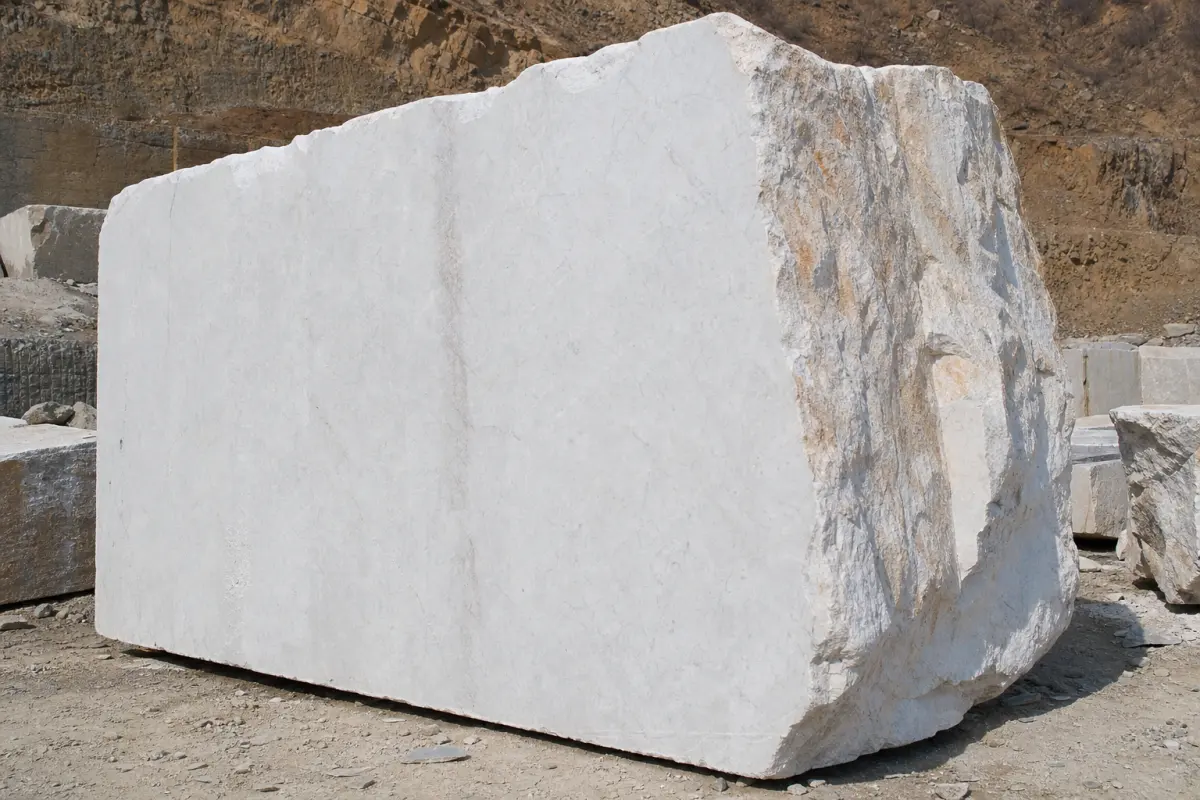
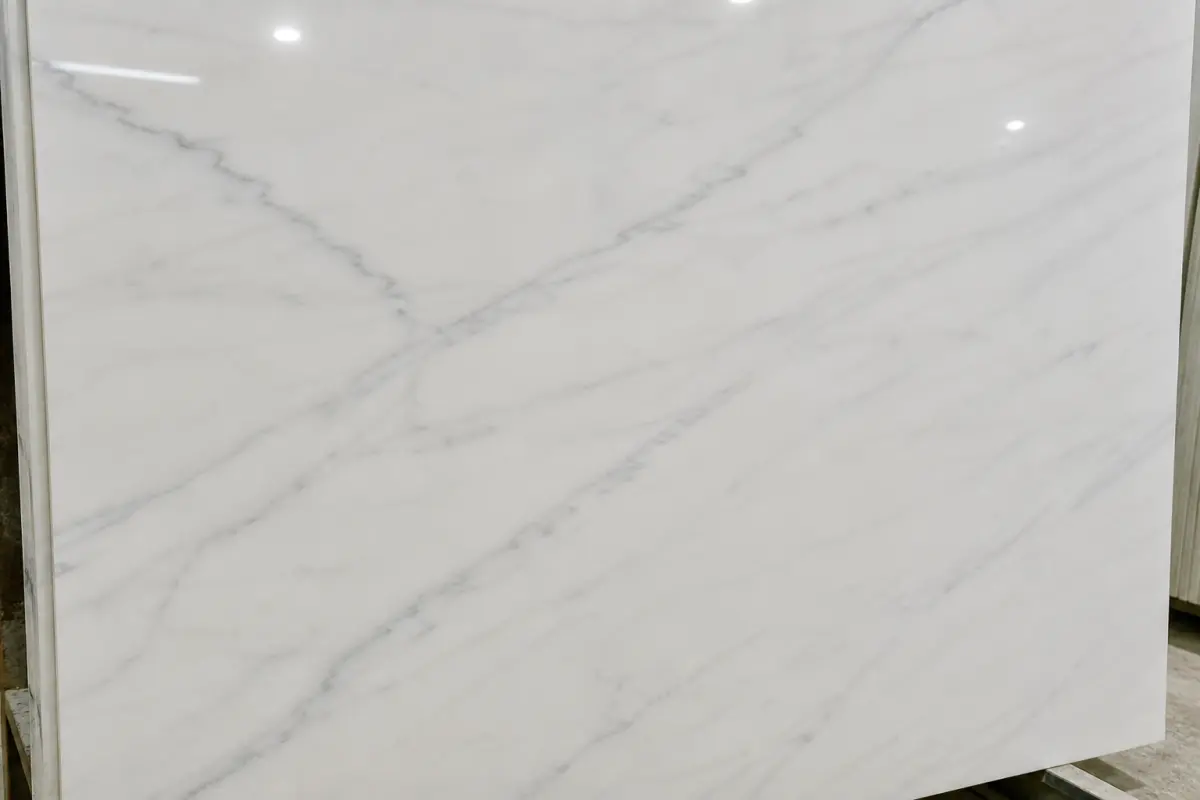
Write the SKU as a product the mill can photograph. The reference listing most GCC buyers start from is Bampokha No.1 white slab—2 cm polished, first selection, limited grey or gold movement. If your programme is monument, thick cladding, or a destination mill that cuts in-house, specify raw Bampokha blocks with minimum dimension, not “block as available.” Asian importers who re-saw in China or Vietnam should still demand block photos with a tape on two faces; a cubic-metre rate without geometry is how you buy fracture.
State the mill location as a union-council or road, not “Buner factory.” Daggar is the district headquarters; the gangsaws that export sit on the Torwarsak and Swari roads, fed by faces at Bampokha, with Nanser black and Chamla–Chagharzai whites and greys in the same trucking catchment. A supplier who cannot name the saw shed is selling a story. Ask for a dated video pan from gangsaw to stockyard and match it to the NTN on the proforma. That is the first filter before brightness talk.
Brightness and background: what GCC lighting does to Pumpoo white
Architects in the Gulf specify marble under two lights that Buner sample rooms rarely reproduce: high-CCT lobby LEDs and harsh noon courtyard sun through glass. Bampokha’s selling point is a relatively clean white field with manageable grey or honey movement. It is not a laboratory-white engineered slab. If your render shows a paper-white floor with no vein, you are specifying a different material—or you are specifying Super White selections that cost more and still need a sample. Cross-shop Super White Buner only when the approved board is brighter than typical No.1 Bampokha; do not treat the two names as synonyms on a BOQ.
Ask for a dry and a wet photo of the same slab. Water and resin change how grey veins read. GCC bathrooms and spa walls fail mock-ups because the mill photographed a dry, dusty slab in shade. Require photos taken after polish, with a colour card or a known grey tile in frame, timestamped. If the factory uses phone HDR, say so in the RFQ: HDR hides yellowing. Asian buyers who install under cooler office lighting should still approve against the same card; the stone does not change nationality at the destination lamp.
Brightness is also a sorting labour cost. First-selection Bampokha is the mill spending hours pulling cloudy slabs out of a block run. Commercial lots from the same face are not “fake”; they are the remainder. If your 4,000 m² mall floor can absorb movement, say so and pay commercial. If your 280 m² hotel reception cannot, pay for No.1 and freeze the lot.
Vein language, selection lots, and bookmatch
Vein talk on WhatsApp is poetry. Vein talk on a spec is density, direction, and whether you will accept gold versus grey. Bampokha commonly shows grey linear movement; some benches throw warmer honey lines that designers either love or reject as “dirty.” Write the allowed family. Photograph three approved slabs and three rejected slabs so the mill has a fence, not a vibe.
Bookmatch is not a default. Sequential numbering from one block, mirrored pairs, and crate packing that preserves order add labour and reduce yield. Many Torwarsak lines can do it; many will not unless you pay and unless the block was wire-sawn with regular faces. If the lobby feature wall needs four bookmatched pairs, state pair count, minimum slab size after trim, and that unmatched leftovers are not to be mixed into the field floor without written approval. If you do not need bookmatch, say “random vein, no pairing” so the mill does not charge for a service you will not use.
Selection lots must be frozen before polish completes. A lot is a set of bundles from named blocks, photographed, and locked. GCC programmes that drip-feed “another 600 metres next month” without a lot number get a different bench. Asian hospitality brands that roll out the same SKU across three cities should treat Bampokha like a dye lot: keep retain samples, keep bundle IDs, and RFQ the same mill. Factories such as Zeex Naturals and Ayaz Marble that publish actual slab SKUs are easier to lot-lock than a trader who buys leftover polish from three sheds in Swari.
Thickness, format, and what a 20-foot crate actually holds
The default Pakistan white marble export pack for Bampokha is 2 cm polished slabs in A-frames. That is what Jebel Ali yards expect, what most GCC fabricators inventory, and what Torwarsak polish lines are set up to produce. Three centimetre appears for stairs, external treads, and some commercial floors where the consultant wrote a thickness that survived value engineering. Do not mix 2 cm and 3 cm in one shade lot unless you like two different gangsaw setups and two different crate weights.
Tiles are a different machine. Buner white 60×60 tiles can match a Bampokha field if they are cut from the same block run and calibrated. They often are not. A villa that wants slab walls and tile floors in “the same white” must say so on one RFQ, one mill, one lot. Calibre, bevel, and rectification belong on the tile line item. Hotels that specify 60×60 for back-of-house and 2 cm slabs for the lobby should still send both samples to the designer on the same day.
Slab length follows the block and the gangsaw. Common export sizes land in the 240–320 cm length band before project trim; width is often 140–180 cm. If your drawing needs 280 × 160 cm clear after edge work, write the minimum net size, not “jumbo.” Undersize slabs become waste in a foreign factory. Oversize fantasies become broken promises when the face at Bampokha is running smaller benches. Ask for a size list with each bundle, not an average that hides the tail.
Wet-area resin, mesh, and what factories actually apply
Calcite marbles take resin because they have pinholes, hairline fissures, and saw marks that polish will advertise. GCC wet areas—showers, spa benches, pool surrounds with the wrong stone—need that conversation in writing. Ask whether resin is applied to the face, whether a fibreglass mesh is glued to the back, and whether the resin is UV-stable enough for a sunlit bathroom. “We fill if needed” is not a spec. “Mesh on all 2 cm slabs for wet zones, face resin on pinholes larger than X, no wax to hide pits” is a spec.
Resin colour must match the field. Grey fill on a white Bampokha slab reads as dirt in a Riyadh villa. White fill that yellows under LED reads as nicotine. Ask for a close-up of a filled pinhole on the approved sample, not a wide beauty shot. Some mills still use cheap polyester that smells and yellows; better lines use clearer epoxies and longer cure. You will not get a laboratory TDS from every Torwarsak shed. You can get a dated close-up and a sentence on the invoice: mesh yes/no, resin yes/no, wax not allowed as a cosmetic finish.
Exterior use is a separate honesty test. Bampokha is a marble, not a granite. Acid rain, irrigation overspray, and desert dust plus poor drainage will etch and pit. If the consultant wants white courtyard paving, discuss honed finish, sealing, and a maintenance regime—or switch the courtyard to a harder stone and keep Bampokha inside. International projects fail when the sample is a polished lobby slab and the drawing is an unsheltered fountain wall.
Extraction method belongs on the RFQ, not in a brochure
Buner faces still mix blasting and diamond wire. Blasted blocks are cheaper and more common on smaller leases; they carry more internal fracture and lower slab recovery. Wire-sawn blocks give cleaner geometry and better bookmatch odds. That is not a morality play. It is yield. If your international project is 1,200 m² of 2 cm No.1 with tight vein control, write “prefer wire-sawn blocks; disclose if blasted.” If you are buying commercial flooring at a price, blasting may be acceptable with a higher waste factor. The mechanics sit in our blasting versus wire-saw note; put the choice on this project’s RFQ so the mill cannot swap methods mid-lot.
Ask which benches at Bampokha are currently wire-equipped. Leases change kit year to year. A mill that saws in Torwarsak may buy mixed blocks from several faces in one week. Your lot should come from a disclosed intake, not “whatever arrived Tuesday.” Photograph block marks. If the mill refuses, you are not buying a spec; you are buying a leftover stack.
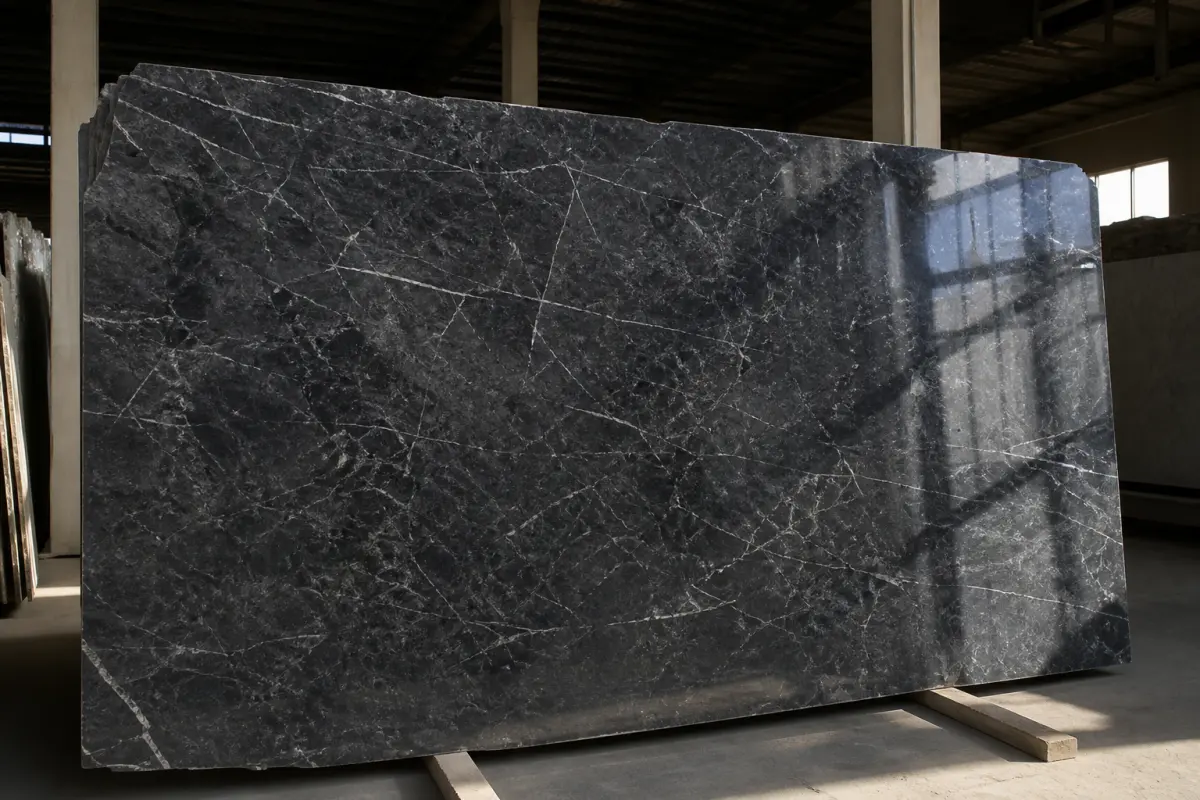
Nanser, Chamla, and Chagharzai sit in the same district conversation but they are not Bampokha. Nanser is the name buyers attach to jet black; Chamla and Chagharzai feed white and grey families that can look adjacent on a dusty yard. Do not let a supplier substitute a Chamla white into a Bampokha-approved lot because “it is all Buner.” Map the mines in our Buner mines guide and the Chamla–Chagharzai supplier note when your designer allows a second origin. For a locked Bampokha international spec, origin is a pass/fail field.
Crate photos, A-frames, and evidence of the lot you bought
International buyers lose money on packing more often than on geology. A-frames must be built for the slab size, strapped, and protected at edges. Wooden members may need ISPM treatment for some destinations. Foam or plastic slip sheets between polished faces stop rub. If the mill shows you a beauty shot of one slab on a stand and then stuffs twenty unlabelled slabs into a crate with no bundle ID, you have no claim when Jebel Ali opens a yellow lot.
Require crate photos before the truck leaves Torwarsak or Swari, and again at the Karachi stuffing point if the Incoterm is FOB. Each photo set should show crate number, slab count, a thickness gauge on one slab, and the chalk mark that matches your lot sheet. Send the same checklist to whoever stuffs at Port Qasim or a Karachi dry port. Breakage on the Buner-to-Karachi haul is a known risk; the question is who owns it. That argument is easier when crate photos exist at both ends.
Do not accept stock images as packing proof. A listing cover is marketing. Your container is the dated crate set attached to the RFQ thread, kept with the commercial invoice.
Bampokha next to Carrara: a spec contrast, not a look-alike contest
Italian Carrara still wins when the brand name is in the interior-design narrative or when the consultant’s office already has a Carrara library. Bampokha wins when the project needs Pakistan white marble export volume, a shorter sample-to-container cycle from a dense factory belt, and a landed cost that survives a Gulf BOQ. That is not the same argument as our Super White versus Carrara cost-and-look piece, which is a different SKU and a different price band. Here the question is whether Bampokha No.1 can pass the mock-up as the field stone.
On a spec sheet, contrast them as follows. Carrara: established vein catalogues, tighter European mill tolerances, higher FOB, longer brand prestige. Bampokha: white-to-off-white field, grey or gold movement that must be lot-locked, tolerances that you write yourself, FOB Karachi from a Malakand mill that actually saws the block. If the designer needs Carrara’s specific grey veining, do not force Bampokha. If the designer needs a bright white floor at a Pakistan origin price, specify Bampokha with the brightness and resin rules above and approve a physical sample in the project lighting.
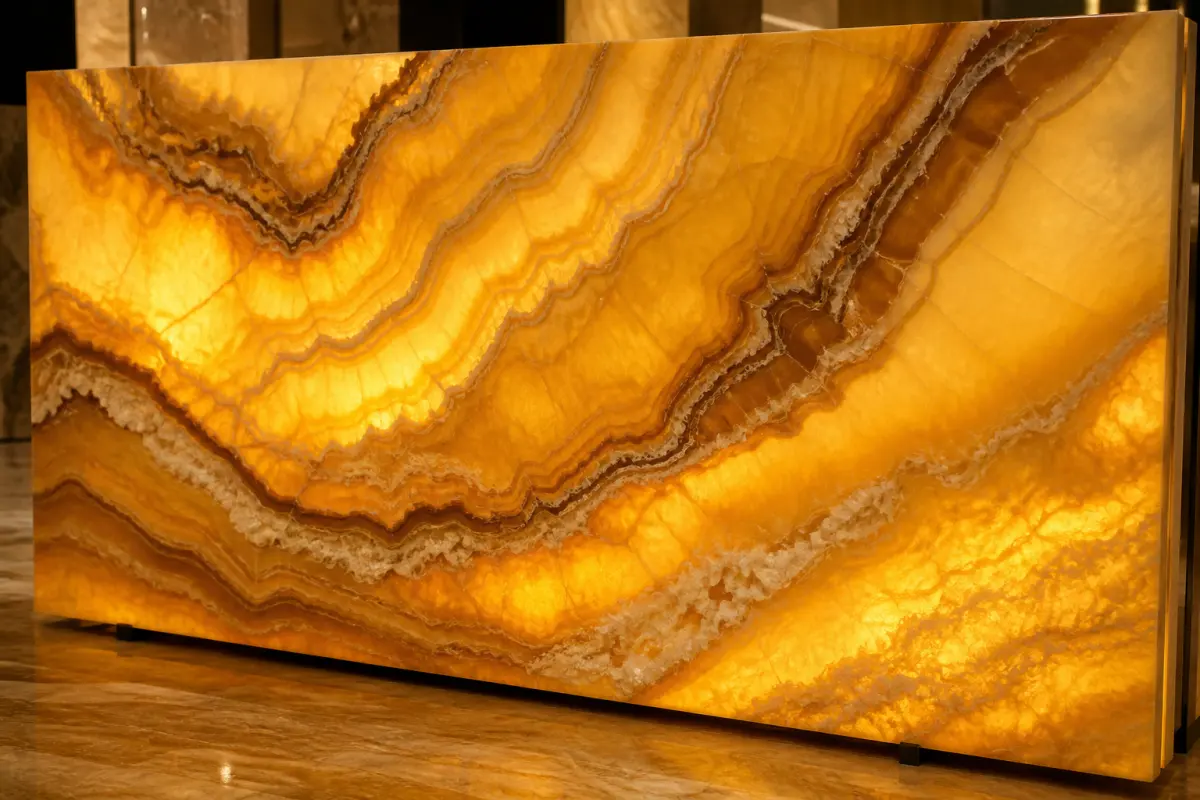
Bampokha is not “the Pakistani Carrara.” It is a Buner calcite Gulf yards already stock. Use that honesty at the mock-up. Feature stones such as honey onyx belong on accent walls, not as silent substitutes for the white field.
Factory geography: Bampokha face, Torwarsak polish, Daggar paper
International specs fail when the buyer thinks “Buner” is a single address. The face is in the hills at Bampokha. The gangsaws and polish lines concentrate where three-phase power and truck access exist—Torwarsak and Swari are the names you will visit. Daggar handles district administration. Mingora in neighbouring Swat handles banks and traders. Karachi handles the vessel. Your spec should name which node is responsible for shade (the mill), which node is responsible for crate photos (the mill, then the forwarder), and which node is responsible for the bill of lading (the exporter of record).
Power is a production constraint. PESCO feeders and load shedding still shape night shifts in the cluster of roughly 500 marble factories that industry briefs place in Buner out of about 700 in Malakand Division. A two-week polish promise in June may slip. Put a production calendar on the RFQ and ask the mill to flag feeder outages rather than inventing dates. Details sit in our Buner electricity note; for this spec, the takeaway is lead time, not politics.
Tax is a document constraint. After the old PATA goods-tax holiday, compliant factories issue sales-tax invoices. An international project whose bank wants a clean commercial invoice should not chase a WhatsApp price that assumes yesterday’s tax. Read the Buner factory tax research with your accountant, then tell the mill “FBR-compliant invoice required” on the spec. Mills that cannot do that are not your exporter, even if the slab is beautiful.
How GCC and Asian project teams should RFQ this stone
Put the spec on one RFQ: origin Bampokha / Pumpoo Khan, selection No.1 or commercial, thickness, finish, resin/mesh, bookmatch yes/no, crate standard, Incoterm (ex-factory Torwarsak versus FOB Karachi / Port Qasim), inspection right, and lot-lock photos. Publish it on the Pakistan marketplace so mills that actually hold white inventory can bid. Attach the three approved and three rejected slab photos. Name destination city so packing and HS description can be drafted once.
If the same programme needs a second white, open a parallel line to Super White rather than blurring names. If the programme needs volume grey for back-of-house, add Badal grey as a separate SKU with its own lot. Hotel packages that mix field white, grey borders, and black vanities should read our GCC hotel marble from Buner note for programme sequencing—not as a substitute for this Bampokha spec.
Dubai and Abu Dhabi importers who already stock Pakistani white in Al Quoz or Ras Al Khor should still lot-lock the next container against this sheet; yard leftovers are not a spec. Start with the UAE importer path for Jebel Ali habits, then return here for the millimetres. Saudi mosque and villa teams should pair this spec with the Saudi sourcing article for shade-lot scale. Grade ladders for export whites live in Buner white export grades. Quarry-cluster contacts sit in Bampokha suppliers.
Bampokha white marble earns international work when the spec is boring and complete: brightness with a card, vein with a fence, thickness with a gauge, resin with a close-up, crates with numbers. That is what GCC and Asian buyers should ask for—and what a Torwarsak mill can actually produce—if you stop buying poetry on WhatsApp and start buying lots on a written RFQ. Use StoneVaults contact if you need help attaching a BOQ to the first enquiry.